
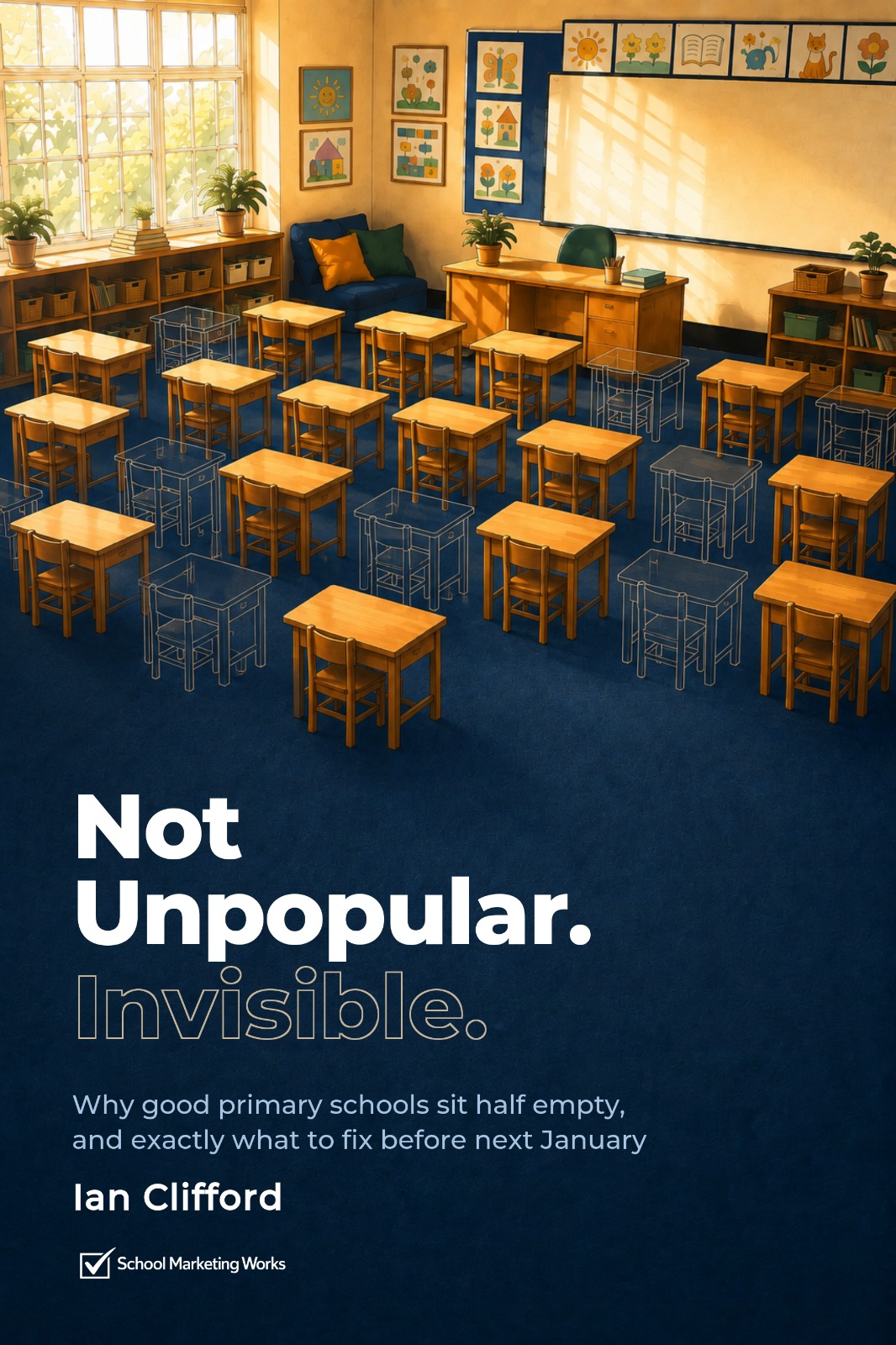
Not Unpopular. Invisible.
Why good primary schools sit half empty, and exactly what to fix before next January.
Most half-empty primary schools are not unpopular. They are invisible. This book is the whole method we use to fix that, in the order we do it, with the campaign that started it running through the middle of it — a one-form-entry school in Lambeth that went from twenty-two children in Reception to a full class, on just over a thousand pounds.
Both formats, one price. Download straight after payment and again any time from your account.
pages
22 chapters
diagrams
toolkit templates
The whole process, laid out in order.
This book arranges everything we know about filling a primary school into a single argument — first this, then that, and here is why it is in this order. If you have a falling roll and no idea where to start, the order of what to do and when to do it is most of what you are missing.
Running through all six parts is what actually happened at one school in Lambeth: twenty-two children in a Reception class built for thirty, and a head who could not work out why. You learn the method and watch it happen at the same time, which is a better way to learn anything.
What is in it
Part One — The problem
Why invisible is different from unpopular, what an empty place actually costs over seven years, and the two problems that look identical on a spreadsheet.
Part Two — What decides it
The Cambridge study of 282 parents. Ofsted came seventh. The two things that decided it cannot be put in any document.
Part Three — Getting seen
Posters and where to put them, advertising that works in 2026, Google Ads, screens and audio, and starting two years early.
Part Four — Through the door
Tours or open mornings, running the event, and the booking page that decides whether any of it turns into applications.
Part Five — What they find
Your website’s two audiences, photography and film, the families who cannot come, and what a parent finds when they search you.
Part Six — Doing it
How to know whether it worked, and what to do if you only ever do three things.
The toolkit
Eleven things you would otherwise have to write yourself: the AI prompt that finds your poster sites, the confirmation email, the nursery letter, the Parent View ask, the booking form, the running order.
And the honest bits
Where the numbers came from, what our own research cannot tell you, and the chapter about heads who feel uneasy about winning families from the school down the road.
Reading it on a Kindle?
Download the EPUB, then go to send.amazon.co.uk, sign in with your Amazon account and drag the file in. It appears on your Kindle and in the Kindle app within a minute or two. Nothing to convert and nothing to install.
The PDF is set at 156 × 234mm, so it reads properly on a laptop or tablet and prints tidily if you want it on paper.
Who it is for
Primary heads and business managers with a falling roll, in an area where there are still children. Our own research found that 59% of England’s under-filled primaries have three or more other primaries within two kilometres, and those schools hold 71% of the empty places.
It is not for everyone. If you are the only primary for two kilometres and your roll is falling, that is a demographic problem and marketing is not the answer. The book says so in Chapter 3 and tells you how to tell the difference. We would rather you knew that before you paid us anything.