
Quick answer: Schools can now run digital billboard advertising for as little as 5p per play, with no minimum spend, using self-serve platforms like CAASie - hand-picking the individual screens near nurseries, leisure centres and GP surgeries where parents of four-year-olds actually stand, and scheduling plays only at the hours those parents are there. A £50 test is genuinely possible. The rule: skip the big roadside boards, buy the small screens in the right places at the right times.
Picture a dad on a Saturday morning, taking the kids to football training. He walks past the same leisure-centre screen every week. Now picture that screen showing your school — a big photograph of happy children, your open day date, your web address. Or a mum or Grandparent after a parent and toddler group staring at the same poster on the bus shelter outside the cafe.
That used to be impossible for a school. Billboard advertising meant agencies, contracts and four-figure minimums, sold by the fortnight to brands with budgets you'll never have.
Not any more. Self-serve platforms have done to outdoor screens what Facebook did to advertising generally: opened the ad platform to anyone, with no minimum spend, letting you pick the exact screens you want on a map and pay only when your ad actually plays. For most businesses that's mildly interesting. For schools, it's close to perfect — because of something unusual about your situation.
Why this suits schools better than almost anyone
Your catchment is tiny. A city primary draws from a mile or two; even a shire school draws from a handful of villages. You don't want "Birmingham" — you want the three screens between your gates and the retail park.
Big advertisers can't buy that precisely without waste. You can't afford to buy any other way. Self-serve screen advertising is the first outdoor medium ever built to match how schools actually need to buy: a few exact places, a few exact hours, a few pounds at a time.
The rule: skip the glamour screens
Here's where the money goes wrong, and it's visible right there in the rate card. On CAASie — the platform we'd start with — the big roadside billboards run from 20p up to £8.50 per play, and train station screens up to £1.60. They're aimed at everyone driving or hurrying past, which for a school means almost no one who matters.
Meanwhile: bus shelters, gym screens and fuel station screens start at 5p a play. Retail and street-furniture screens from 7p. GP and medical centre waiting-room screens from 8p.
The cheap screens are the good screens — for you. Because you're not buying audience volume; you're buying specific pavements.
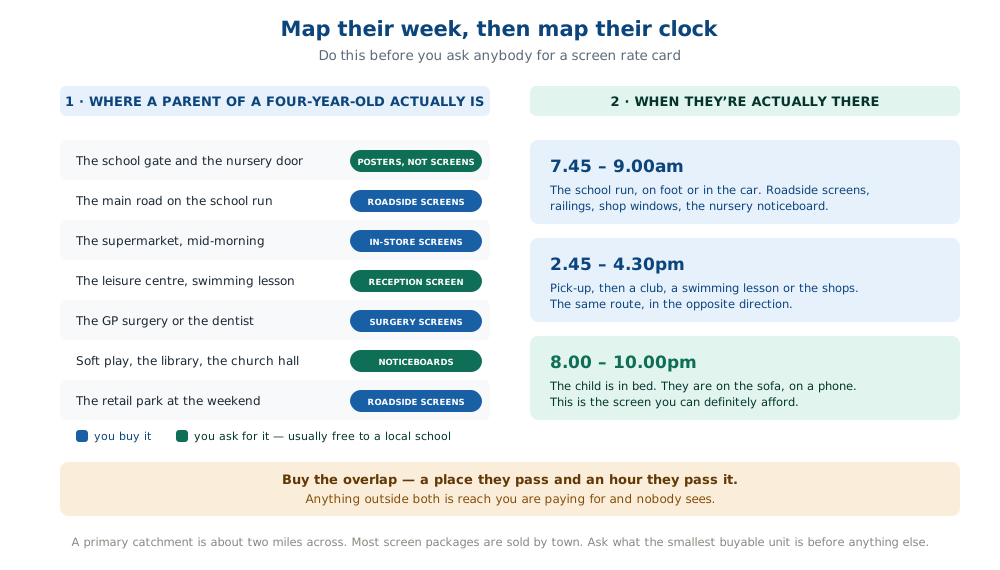
Map their week. Then map their clock.
The whole targeting method is one exercise: sit inside the head of a parent of a four-year-old and map their week. The nursery run. The swimming lesson. The mums landing at the coffee shop after zumba. Soft play on a wet Tuesday. The supermarket. Saturday-morning football. The bus stop outside the nursery.
Then map their clock, because self-serve platforms let you schedule by day and hour. You don't pay for a screen at 2am on a Tuesday — you pay for the screen facing the café at 10:15 on class morning, and the leisure centre from 8 to 11 on Saturday. Five well-chosen screens at the right hours beat one famous screen running all day, for a fraction of the money.
And the holy grail, if your area has one on the network: the GP waiting room. Nowhere on earth has a higher concentration of parents of small children, sitting still, with nothing to look at. High dwell time, QR-friendly, from 8p a play. If a surgery screen inside your catchment is available, take it before anything else.
(If you've read our poster guide, you've already done most of this thinking — the venue list you built for poster drop-offs is your screen shortlist too. Same parents, same places.)
Your poster is already the ad
Most of these small-format screens are vertical — portrait, like a phone. So is your A4 open day poster. The same artwork adapts almost straight across: a light resize to the screen's exact pixels, and — the one real design change — text noticeably bigger than feels natural, because screen viewers are further away and glancing, not reading. (Platforms typically want static PNG or JPEG at exact resolutions, most commonly 1080×1920 portrait, and they'll tell you precisely what each screen needs at upload.)
The exception: GP waiting-room TVs are usually landscape, like a telly — so the holy grail needs a landscape version of your artwork. Worth every minute of the rearranging.
Everything you already know about the poster applies: one big photograph of happy children looking at the camera, school name, visit date, web address, don't overload it. One asset, designed once, now working on playgroup notice boards, in feeds — and on screens.
One rule on QR codes: fine on screens where people are standing or sitting still — bus shelters, gyms, waiting rooms — but keep them off anything roadside. Nobody should be scanning at 30mph, you shouldn’t book those sites, and the platforms restrict it anyway.
Measuring it, honestly
Screens are an awareness channel, and awareness is hard to attribute — anyone who tells you otherwise is selling something.
Do three cheap things and read them together: put a unique QR code (pointing at your visits page with a tracking tag) on the still-audience screens; keep "how did you hear about us?" on your booking form and tour check-in sheet; and watch your booking-page traffic against the days and hours your plays ran. Imperfect — but between those three you'll know whether it's working, which is more than most billboard advertisers have ever known.
You'll need to do this to attribute traffic that you get from any radio advertising as well. This isn't such an issue with your Facebook advertising and you should have that in place before you start testing billboards.
What it costs, and where to buy
At 5p a play, £50 buys around a thousand plays in exactly the right postcodes at exactly the right hours. Run it as a September–November burst when families are choosing, plus a final week before the January deadline. As experiments go, it's the cheapest "big school energy" money can buy.
Where to buy: start with CAASie — no minimum spend, no platform fees, per-screen picking, hour-level scheduling, and the rate card above. Check its map over your own postcode first: coverage is strongest in the big cities (London, Birmingham, Manchester, Leeds, Bristol, Sheffield among them), thinner elsewhere.
And keep an eye on this space, because it's evolving fast. AdPower — launched by Global in mid-2026 — is self-serve access to Global's enormous street-screen network (plus, curiously, radio in the same portal), and may well cover towns CAASie doesn't. If you're outside a major city, price your patch on both before deciding.
The bigger picture
Screens are one layer of one stage — the REACH stage — of the system we use to fill school classes: research, website, visit bookings, local visibility, follow-up, deadline push. If the whole machine interests you, it's all in our published case study and the Fill Your Class Funnel.
And if you're not sure whether screens (or anything else) are what your school needs, that's precisely what our Marketing Health Check answers.
Sources
- Jon Loomer — Meta Ads Targeting 2026 (Advantage+ audience, detailed targeting as suggestions)
- Meta Advantage+ audience vs detailed targeting, 2026 guide (exclusions removed from Ads Manager 2025 and boosted posts June 2025; January 2026 interest-category removals)
- GOV.UK — Schools block funding formulae 2026 to 2027 (minimum £5,115 per primary pupil)
- DfE — National pupil projections
- School Marketing Works — the falling school roll case study, 2019
Frequently asked questions
Can schools advertise on digital billboards cheaply?
Yes. Self-serve platforms like CAASie have no minimum spend and sell small-format screen plays — bus shelters, gyms, fuel stations — from around 5p per play in the UK. A £50 test campaign buying roughly a thousand plays near your school is realistic. The expensive mistake is buying large roadside billboards, which cost 4–170× more per play and reach mostly the wrong people.
Where should a school place digital screen ads?
Where parents of your entry-age children already stand or sit: bus stops near nurseries, leisure-centre and gym screens, supermarket and retail screens, and — best of all where available — GP waiting-room screens, which combine parents of young children with long, captive viewing time. Map a local parent's typical week, then schedule plays only for the hours they're there.
What artwork does a school need for digital screens?
Usually a static image (PNG/JPEG) at each screen's exact resolution — most small-format screens are portrait (commonly 1080×1920), so a well-designed A4 open day poster adapts almost directly; GP waiting-room TVs are typically landscape. Keep it simple: one big photo of happy children, school name, open day date, web address — with text larger than feels natural, because viewers glance from a distance.
How do you measure billboard advertising for a school?
Imperfectly but usefully: a unique QR code on still-audience screens (bus shelters, waiting rooms) linking to your visit-booking page with a tracking tag; a "how did you hear about us?" question on booking forms and tour check-ins; and comparing booking-page traffic to the hours your ads played.
Which self-serve billboard platform is best in the UK?
For hand-picked, small-budget school campaigns, CAASie is the strongest starting point (no minimums, per-screen selection, hourly scheduling, from ~5p a play), with coverage concentrated in major cities. AdPower, Global's self-serve platform launched in 2026, opens up Global's street-screen network and may suit schools outside the big metros. The space is evolving quickly — check coverage maps for your own postcode before committing.
Ian Clifford is the co-founder of School Marketing Works, and has been running admissions marketing campaigns for UK schools since 2018 — including the one in our published falling school roll case study.