
Quick answer: Word of mouth is the second thing parents rely on when choosing a primary school, ahead of your website and ahead of Ofsted — and since Google deleted school reviews, your social media is the closest thing to a public opinion of your school that exists. Instagram and Facebook, made once and shared across both.
Three or four posts a week, about an hour of someone's time, and a rule that stops the page going quiet every time consent gets complicated. And if you're asking a member of staff to do it, there are three legitimate ways to pay them for it.
Why this is admissions, not communications
When 282 parents were asked where they got their information about schools, word of mouth came second — behind open days, but ahead of school websites and ahead of Ofsted reports.
You can't buy word of mouth. You can feed it.
And it matters more now than it did two years ago, for two reasons. Google deleted the reviews from every school's listing in April 2025, so the easiest public verdict on your school no longer exists. And the Good Schools Guide's 2026 research found 16% of parents now turn to social media when weighing up schools, rising to 29% among Gen Z parents — against only 31% who look at inspection reports at all.
A parent scrolling three months of your posts forms the impression a review used to give them. That's the job it's doing, whether or not anybody at the school thinks of it that way.
What a quiet page says
The most common problem isn't a bad post. It's a page whose last entry was in March.
A parent who finds that doesn't think "they're not very active on Facebook". They wonder what else has stopped. Nothing you write is as loud as a four-month gap.
Which is why consistency beats quality here, and why the whole of the rest of this article is about making the thing sustainable rather than making it impressive.
Instagram, Facebook, or TikTok?
Instagram and Facebook. Both, made once.
Make it in Instagram. It's the more used of the two at the younger end of your prospective parents, it's built for exactly the kind of visual, ordinary content this article is about, and — the practical reason — the weekly five-photograph carousel only travels one way. Meta will share posts, Stories and Reels between a Facebook Page and an Instagram account in either direction, but a multi-image carousel going Facebook to Instagram isn't supported. Build the week in Instagram and it reaches both. Build it in Facebook and the one format you rely on stays stuck there.
But don't treat the Facebook page as an afterthought. Plenty of parents are still in Facebook every day, the local groups where things actually get shared are there rather than on Instagram, and your Facebook page is often on the first page of results when somebody searches your school's name. It does the local work even while Instagram does the impressing.
Set the sharing up once in Meta's Accounts Center and it runs by itself after that. It’s fine to publish the same thing to both at the same moment, but anyone following you in both places sees it twice. To avoid that you could stagger by a few hours, But for whoever you've tasked with the job that needs a second moment when they have to switch their attention to it. Honestly, we wouldn't worry about it.
TikTok, almost certainly not. Everything else in your marketing is aimed at roughly a two-kilometre radius. TikTok is the one platform built to do the opposite. It will happily find you an audience three hundred miles away, and a video seen by 200,000 people who can't apply to your school has cost you an afternoon and bought nothing.
The safeguarding shape is different too — duet and stitch let strangers recontextualise footage containing children, which isn't the same risk as a page seen by four hundred local families.
TikTok isn't wrong for everyone. It makes more sense for secondaries, and for staff recruitment. It's wrong for a primary looking for thirty families within walking distance.
And if you've got an old Twitter account, it's doing very little for parent reach. Keep it for snow days if you like. Don't start one.
The consent question, and why pages go quiet
Here's the honest position. A photograph of a child enjoying their school day is the most persuasive image your school owns. It's also the thing everyone is most frightened of getting wrong. So the safest-feeling option is to post nothing, and that is what a lot of schools do.
Faces are your strongest photographs. Not every post needs one.
Get the hero images done properly, once or twice a year, with consent sorted carefully for exactly those pictures — that's what a proper photography shoot is for, and those images should be working hard on your website, your prospectus and your open day poster.
What they can't do is carry forty weeks of posting. If every post needs a consented face, every child you're unsure about becomes a reason to post nothing.
So the weekly rhythm runs on everything else as well:
work on a desk — books, models, artwork
hands doing something: pouring, planting, painting, building
a wide shot of a busy classroom where nobody is identifiable
the reading corner on a wet Tuesday
muddy boots by the door after forest school
sport photographed from behind
the corridor display that took somebody three evenings
None of those needs a consent form, and several of them say more about your school than a posed group photograph does.
The rules worth knowing
The highest-risk combination is a face, in uniform, with a name. Any two of those is a decision; all three on a public platform is the thing to avoid.
Consent should be granular and withdrawable. A parent should be able to say yes to the newsletter and no to Instagram, and to change their mind later, with a clear route for doing it. A single tick box at enrolment covering everything for seven years isn't really consent.
And consent may not be the right basis anyway. The ICO points out that consent has to be freely given, and there's an inherent power imbalance between a school and a parent — so it isn't always the appropriate lawful basis for processing. The Data (Use and Access) Act 2025 added a new 'recognised legitimate interest' basis and ICO guidance is currently under review as a result.
That's a conversation for your data protection officer, not for a marketing article. What matters practically is that you have a register whoever posts can actually see, and that you check against it every time.
The rule your governors will want to hear: if you wouldn't put it on the school website, don't put it on social media.
And a short list of never: surnames alongside images, anything about behaviour or discipline, emotional incidents, public responses to complaints, and anything identifying a child who is looked-after or has a protected identity.
What to post
Roughly this mix, over a term:
Share | What | Examples |
|---|---|---|
35–40% | Life of the school | Trips, clubs, performances, sports day, assemblies |
25–30% | Learning in action | Hands-on lessons, experiments, music, group work |
15–20% | Values and culture | Kindness, inclusion, charity work, eco, house events |
10–15% | Admissions | Open events, deadlines, the things a new family needs |
5–10% | Staff and governance | Staff spotlights, a day in the life of a TA |
Show, don't sell. Not "we have a brilliant forest school" — a photograph of muddy boots by the door, captioned "Forest school, Thursday."
The things to keep surfacing are the ones prospective parents actually ask about and current parents forget are unusual: breakfast club, after-school club, forest school, the residential, music, sport, SEND provision, small classes, one-form entry. These are the things that we advise schools to highlight in their Facebook advertising when they are applying the ‘Fill Your Class’ funnel strategy in their marketing. They work just as well, perhaps even better, when they are recurring themes in organic social posts.
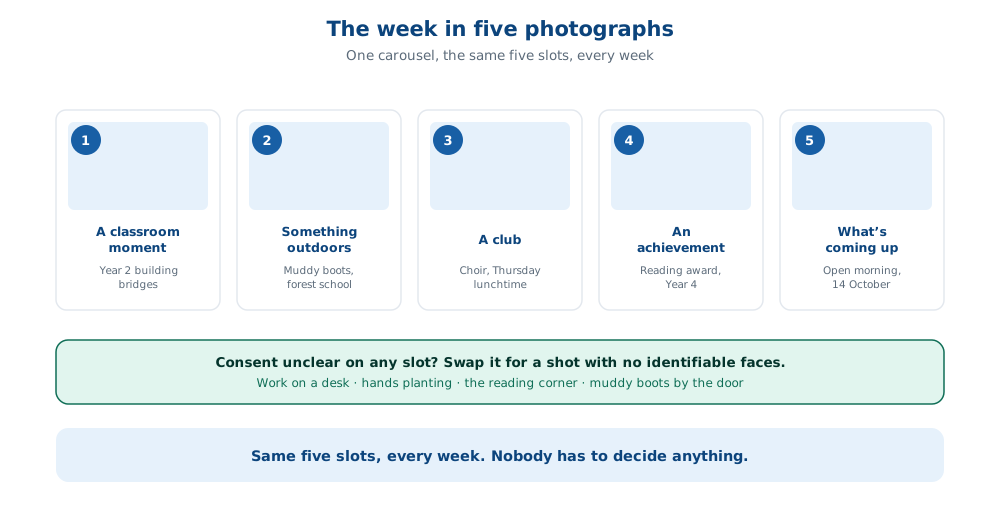
The anchor: one carousel, every week
Five photographs, same slot, every week, built in Instagram: This week at [School].
A classroom moment
Something outdoors
A club or enrichment moment
A pupil or staff achievement
What's coming up
It's repeatable, it shows breadth rather than the same three children, any slot can be swapped for a face-free shot if consent is unclear, and it gives the head one sentence for governors: every week we show our community what's happening in five photographs.
The year, roughly
Most social calendars tell you to post about World Book Day. This one has a second column, which is the part that fills a Reception class.
Month | School life | Admissions layer |
|---|---|---|
September | New term, Reception settling, clubs launch | Open events begin. Book-a-visit posts start |
October | Black History Month, harvest, parents' evenings | Open events peak. Deadline first mentioned |
November | Remembrance, Anti-Bullying Week, nativity rehearsals | Last open events. Say the deadline out loud |
December | Nativity, carol concert, fair, end of term | Deadline reminder before everyone disappears |
January | Back to school, new clubs | 15 January — final push. Then stop |
February | Half term, Safer Internet Day | Toddler group and stay-and-play promotion |
March | World Book Day, British Science Week | |
April | Easter, spring term ends | 16 April offer day — welcome your new families publicly |
May | Sports day prep, walk to school week | Transition begins |
June | Sports day, residentials, trips, summer fair | Stay-and-play for September starters |
July | Y6 leavers, reports, awards, goodbyes | Summer reassurance for new starters |
August | Quiet — schedule ahead | Uniform and first-day reminders |
The 16 April post is the one schools miss. Welcoming the families who chose you is also the most persuasive thing the families who didn't will see all year.
An hour a week
Choose — 10 minutes. Look at the calendar. Pick one post. A second only if the week gave you one.
Make — 20 minutes. Open the template, drop the photograph in, write one or two sentences. No caption longer than three lines.
Post — 5 minutes. Publish or schedule. Stop.
When you're stuck: something being learned goes in the learning template. An event coming up goes in the reminder template. A proud moment goes in the achievement template. A quiet week goes to the calendar. No thinking required, which is the entire point.
Who owns it matters more than who does it. One named person, plus a couple of people in each phase who send photographs to a shared folder or a WhatsApp group. Never one person alone — when they leave, the account leaves with them, and half the schools reading this have a page nobody can log into for exactly that reason.
Comments
Professional and warm. No sarcasm, no in-jokes that read badly to a stranger.
Never argue in public. Reply once — "thanks for your comment, please email or ring the office so we can look into it properly" — and take it offline. Deleting or hiding should be a written policy rather than a judgement made at nine at night.
A page with a consistently warm tone gets defended by its own parents. That's the real return on the tone of voice.
How to pay somebody to do this
This is the part nobody writes about, and it's the reason most school social media fails. It gets added to a job that was already full.
An hour a week is real work. There are three legitimate ways to pay for it.
A TLR3, for teachers. Designed for exactly this: a fixed-term, project-shaped responsibility with the duration agreed at the outset. Worth between £702 and £3,478 in 2025-26, rising to £731–£3,599 for 2026-27. Usefully, the pro-rata principle doesn't apply to TLR3 — a part-time teacher receives the full amount, not a fraction of it. "Communications lead" or "parent engagement lead" justifies it comfortably.
Additional hours for support staff. Schools on NJC Green Book terms have several routes: contractual overtime, a temporary honorarium for additional or special duties — typically short-term, up to around six months, and normally pensionable — or simply varying someone's contracted hours to include the work. An office administrator with three hours a week written into their contract is the most common version of this and the most durable.
A small dedicated role. Plenty of schools employ a part-time communications assistant for three to ten hours a week on support staff scales. Advertised, paid properly, approved by the head and governors.
The detail on all of this sits in your own pay policy and differs between local authorities and trusts, so your HR provider is the person to ask. But the routes exist, they're ordinary, and somebody in your building has almost certainly been paid through one of them for something else.
What a head can't do is quietly add it to someone's Tuesday. Not cash in hand, not an unrecorded stipend, and not a teacher's unpaid time outside directed hours — the 1,265 hours are the 1,265 hours.
How you know if it's working
Three checks, once a month:
Does the page look active?
Would a stranger scrolling for thirty seconds feel reassured?
Can they see what the school is actually like?
Likes don't matter. The only number that does is how many people clicked through to book a visit — which is why every open event post should carry that link, and why the booking form should ask how people heard about you.
Where this sits
Social media is the only part of your reputation you control outright. It sits alongside what a parent finds when they search you, and both of them exist to get a family to the point of booking a visit.
If you'd rather it was done for you, or done properly once and handed over, that's what we do. If you want to know where your gaps are first, the Marketing Health Check takes fifteen minutes.
Frequently asked questions
Should a primary school be on Instagram, Facebook or TikTok?
Instagram and Facebook, with the content made in Instagram and shared across. Meta will share between the two automatically, but a multi-image carousel only travels from Instagram to Facebook — and the carousel is the format worth building your week around. Facebook still matters because the local parent groups are there and the page tends to appear when somebody searches your school's name. TikTok optimises for reach beyond your catchment, which is the opposite of what a primary needs.
How often should a primary school post on social media?
Three to four times a week is a realistic target for a school without a dedicated communications person. Consistency matters far more than volume — a page with a four-month gap says more to a prospective parent than any single post.
Can we post photographs of children on school social media?
Yes, with proper consent arrangements. The highest-risk combination is a face, in school uniform, with a name attached, and that should be avoided on public platforms. Consent should be granular and withdrawable, and your data protection officer should confirm the lawful basis — ICO guidance is currently under review following the Data (Use and Access) Act 2025.
What do we post if we can't show children's faces?
Work on desks, hands doing things, wide classroom shots where nobody is identifiable, displays, the reading corner, muddy boots after forest school, sport from behind. None of it needs a consent form and it tells a prospective parent more than a posed group photograph.
Who should run a school's social media?
One named person who owns it, with a few staff feeding photographs in from each phase. Never one person alone — accounts get lost when that person leaves.
Can a school pay a member of staff to run its social media?
Yes. Teachers can be paid through a TLR3, worth £702 to £3,478 in 2025-26 and not subject to the pro-rata principle. Support staff can be paid through contractual overtime, a temporary honorarium, or a variation to their contracted hours. Some schools create a small part-time communications role. The detail sits in your own pay policy.
How much time does it actually take?
About an hour a week once a calendar and templates exist — ten minutes choosing, twenty making, five posting, and a little slack.
How do we measure whether it's working?
Clicks through to your visit booking page, and asking every family at the point of booking how they heard about you. Followers and likes tell you very little.
Ian Clifford is the co-founder of School Marketing Works and has been running admissions campaigns for UK schools since 2019, including the one documented in our published falling school roll case study.
Sources: School Teachers' Pay and Conditions Document 2025 · NJC Green Book terms and local authority support staff pay policies · ICO, taking photos in schools · The Good Schools Guide research, 2026 · CUSPE / Cambridgeshire County Council, 2018