
Quick answer: On 30 April 2025 Google removed reviews and star ratings from every school's Business Profile worldwide, and deleted the ones already there. Nothing replaced it, and chasing reviews across five different school websites is five jobs nobody will do. There's one worth doing — Ofsted Parent View, which is free, official, publishes as soon as ten parents have answered, and counts at inspection.
Make it a goal to get ten responses every year. After that, the useful work isn't reviews at all. It's making sure your own website says everything a parent, or the AI they're asking, needs to know.
The thirty seconds that decide it
A parent hears your school's name — at a toddler group, from a neighbour, off a poster. What they do next is always the same. They type it into their phone.
Back comes a small, fixed set of things: your website, your Ofsted report, a map listing, your Facebook page, one or two school data sites, and occasionally a forum thread from three years ago. That first screen is your reputation, and most heads have never looked at it as a whole.
What Google did
On 30 April 2025 Google began removing reviews and star ratings from every Business Profile categorised as a school. Worldwide, state and independent alike, and it deleted what was already there rather than hiding it. Nothing new can be left.
Google's reasoning is that schools, like hospitals, are critical services, and the change protects them from review-bombing. Anyone who has watched a Year 11 cohort discover their school has a public star rating will recognise the problem it solves.
For a school carrying a bruised rating it was a quiet mercy. For everyone else, it removed the easiest place a happy parent could say so.
Your Business Profile still earns its keep — the map, contact details, term dates, photographs, and Google Posts for open events. It just no longer says anything about whether people like you.
The one thing worth asking parents to do
Ofsted Parent View is the survey your school already has and almost certainly ignores.
Parents can complete it at any time, not just when inspectors are in. Ofsted rewrote it on 10 November 2025 to align with the renewed inspection framework, and it's now ten short questions: whether a child is happy, feels safe, whether pupils are well behaved, whether the school communicates well, whether concerns get dealt with properly, whether decisions are taken with the child's best interests at heart, whether the child gets the right support to learn well, plus conditional questions on bullying and SEND.
The last one is simply: would you recommend this school to another parent?
That figure is the closest thing to a star rating any school now has.
Nothing a parent writes is ever published
Worth being clear about, because it's the first thing a nervous head asks.
There is no comment box outside an inspection. During an inspection one appears for a limited time, and those comments go privately to inspectors, anonymised — Ofsted never publishes them and schools never see who said what. Only one response per parent per school per year is kept, and a later one replaces the earlier.
So nobody can post a paragraph about your school. Parent View is structurally incapable of the thing that got Google's reviews killed.
The threshold, and the number that should worry you
Results become publicly visible once ten parents have answered — and that applies to each question separately. They appear as percentages and bar charts on a page attached to your Ofsted listing, which is for most schools the second thing a searching parent clicks.
Across state-funded schools the response rate was 4.7% in 2023-24. Roughly one parent in twenty. Independent schools manage more than twice that.
So there's a free, official, permanently open, publicly visible parent survey attached to the page prospective families look at, and ninety-five per cent of your parents have never touched it.
Two things a parent sees that you probably haven't
Your page has a tab for every year, and the empty ones show. A school we work with has tabs running from 2019/20 to the current year, with data in exactly one of them — the year they were inspected, when somebody sent the link out. Every other tab is blank, because a year only appears if it reached ten responses. A parent clicking through doesn't conclude that Parent View is unpopular. They conclude that this school asked its parents once, when it had to.
And the threshold bites question by question. At that same school, most questions published. The one that didn't was the SEND question — "does your child have special educational needs and/or disabilities?" and its follow-up about whether the school gives them the support they need. Fewer than ten parents answered it, so nothing shows.
There's a good reason for that: Ofsted sets the threshold on the SEND and bullying questions specifically so individual parents can't be identified. But the effect is that the question most likely to be read by a family with an additional-needs child sits there saying nothing. That school's SEND provision is genuinely good. You wouldn't know from the page.
The reason nobody does it, and how to get round it
Parent View makes parents register with an email address and password. That's the whole problem. Send a link home and most people never get past the registration screen, which is exactly why the response rate is what it is.
Ofsted will give you guest accounts. There's a request form linked from Ofsted's guidance for schools — allow at least five working days — and they'll set up logins your school can use on its own computers or tablets. The parent doesn't register, doesn't need an email address, and doesn't have to remember anything.
Which turns this from a nagging campaign into one piece of furniture: a tablet on a table by the door at parents' evening, and somebody friendly next to it.
One practical warning from Ofsted's own guidance — some school networks block secure sites and will need that restriction lifted before the tablet works. Worth finding out the week before rather than on the night.
The target is ten. Every year.
Ten responses is the publication threshold, so ten is the goal. Not a campaign, not a strategy — ten people, once a year, and your page never has a blank year in it again.
And it's easier than it sounds, because ten responses isn't ten families. Each parent or carer can complete their own survey, as long as they use different email addresses. Five couples clears the threshold.
On who to ask: start with your happiest Reception parents, because they chose you recently and are speaking to exactly the experience a prospective family is trying to imagine. Then a few from each year group, so it isn't all one cohort. If your SEND provision is a strength you want visible, you'll need to ask those families specifically, because that question needs its own ten.
You're asking for feedback, not for praise, and you should say so in those words. But there's nothing wrong with deciding who gets invited to the tablet.
Do it every year and by year five you have five years of published results sitting on the page a prospective parent lands on, showing a school that has been asking the same questions for half a decade and isn't afraid of the answers. That's a completely different object from one lonely tab marked 2023/24.
The argument that gets it into the diary
This is the only reputation work that also helps you at inspection.
Parent View is Ofsted's main route for hearing from parents, and responses given during the year may feed the annual risk assessment that helps decide if and when you're inspected — though Ofsted is clear they don't on their own trigger anything.
Which gives you the line a headteacher used in Ofsted's own materials: when inspectors, and other parents, look at your Parent View page, you don't want them looking at a blank sheet.
Then search yourself, incognito
Open a private browser window and search your school's name on a phone. Whatever comes back is what a parent sees.
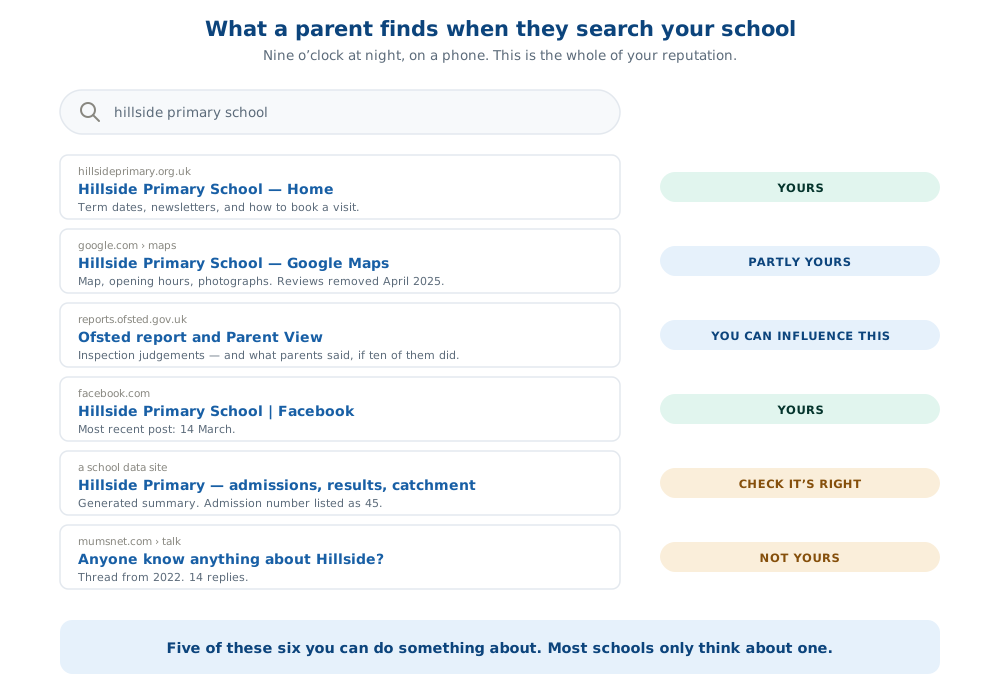
Some of it you can influence. A few school review sites do take parent reviews, and if one of them is on your first page, it's worth ten minutes and worth pointing a couple of parents at. If none appear, ignore them entirely — a review nobody sees is a review that doesn't exist.
That's the whole test. Not "which platforms exist" but "which ones actually show up for us". It varies school by school and takes five minutes to find out.
Two things you'll see that aren't worth chasing. Facebook replaced its star ratings with Recommendations years ago and they're largely dormant; your page earns its keep by being alive, not by being reviewed. That said, many schools do see those old reviews appearing in their Google My Business Profile and in search results. If that is the case at your school, do ask a few parents each term to leave a recommendation on Facebook. It can do no harm. And the Good Schools Guide is written by its own editors and consultants rather than by parents — you can't submit to it, pay for it, or opt out of it, so there's nothing to do either way.
The sites that write about you without asking
There's a growing tier of school data sites that rank well for a school's name, carry official figures alongside automatically generated summaries, and offer no way for anyone to review or correct anything.
They're worth knowing about for one reason. On one of these, for a school we work with, the admission numbers were simply wrong.
Here's the useful part: most of that data originates from Get Information About Schools, the Department for Education's own register. It's where Ofsted Parent View gets your address and roll from, and it's what the aggregators scrape. If something material is wrong — your published admission number, contact details, age range, phase — the fix is upstream. Schools update their own record by signing in to DfE Sign-in, and corrections work their way outward from there.
Worth an hour once a year, and almost nobody does it.
Why that matters more than it used to
The Good Schools Guide's 2026 research found that 23% of parents now use social media or AI when weighing up schools, rising to 37% among Gen Z parents. Only 31% said they used inspection reports at all. And 12% used AI tools such as ChatGPT, rising to 16% among the youngest parents.
An AI assistant answering "tell me about this primary school" can only repeat what it finds written about you. If a data site has your admission number wrong and your own website doesn't state it clearly, the wrong number is what a parent gets told — in a confident voice, with no indication that anybody checked.
So the most valuable reputation work available to a primary school right now isn't a review at all. It's making sure your own site plainly answers the things people ask: what time wraparound care starts and what it costs, how many places you have, how and when to apply, whether a family can come and look round, what happens if their child has additional needs. In sentences, on pages, not buried in a PDF.
Your website is competing to be the source the machine believes. There's more on what a prospective parent needs to find there.
The other half of a local reputation
Reviews were never the whole of it anyway.
The other thing that shapes what people locally think about your school is the steady drip of what you put out yourself. A school that posts something warm and ordinary once a week has an impression working for it in the community all year — one you write, rather than one you wait for.
It isn't a review and doesn't pretend to be. But it's the only part of your reputation you control outright, and for most primaries it's doing more work than any review site ever did. That's a subject of its own.
What to do this term
- Search your school's name on a phone, incognito, and screenshot the first screen.
- Check your Google Business Profile — hours, term dates, contact details, and a dozen decent photographs.
- Look at your Parent View page. How many years have data in them?
- Request guest accounts through Ofsted's form, at least five working days before your next parents' evening. Check your network doesn't block the site.
- Put a tablet by the door with somebody friendly next to it, and get your ten.
- Check your Get Information About Schools record and correct anything wrong.
- Read your admissions page out loud and ask whether it answers the five questions a parent would actually ask.
Where this sits
Reputation runs all year rather than in a season, and it's the one thing you can't buy with Facebook advertising at short notice in October.
This social media ‘how to’ post lays out a solid approach that you can do yourself, but if you’d rather hand it off, we can do it for you. And if you want to know where your gaps are before deciding anything, the Marketing Health Check takes fifteen minutes and will highlight the parts of the ‘Fill Your Class’ funnel that you should focus on.
Frequently asked questions
Why have our Google reviews disappeared?
On 30 April 2025 Google removed reviews and star ratings from every Business Profile categorised as a school, worldwide. Existing reviews were deleted rather than hidden, and new ones can't be left. Google classes schools alongside hospitals as critical services and made the change to prevent review-bombing.
Where should we send parents to review our school now?
Ofsted Parent View. It's free, official, permanently open, and publishes publicly once ten parents have answered a question. If another review site happens to rank on the first page for your school's name, that's worth a look too — but only if it actually appears.
What questions does Ofsted Parent View ask?
Ten, revised on 10 November 2025 to align with the renewed inspection framework. They cover happiness, safety, behaviour, bullying, SEND support, communication, how concerns are handled, whether decisions are taken in the child's best interests, and whether the child gets the right support to learn well. The last question asks whether the parent would recommend the school.
Can parents leave written comments on Ofsted Parent View?
Only during an inspection, for a limited period, and Ofsted never publishes them. They go to inspectors anonymously and schools don't see who wrote what. Outside an inspection there's no comment box at all.
How many responses do we need before our results show?
Ten, for each question separately. The SEND and bullying follow-ups have their own threshold, which exists so individual parents can't be identified.
How do we get parents to complete it?
Request guest accounts through the form on Ofsted's guidance page, allowing five working days, then let parents complete it on a school tablet without registering. Parents' evening is the best moment. Remember each parent or carer can complete their own survey, so ten responses is five couples.
Do parents really use AI to choose a school?
A growing number do. The Good Schools Guide's 2026 research found 12% of parents used AI tools such as ChatGPT when weighing up schools, rising to 16% among the youngest, while only 31% used inspection reports. Those tools can only repeat what your website and other sites say about you.
Ian Clifford is the co-founder of School Marketing Works and has been running admissions campaigns for UK schools since 2019, including the one documented in our published falling school roll case study.
Sources: Ofsted Parent View: guidance for schools, GOV.UK (revised 27 November 2025) · Ofsted Parent View FAQs · Get Information About Schools · Tes, on Parent View response rates · The Good Schools Guide research, 2026