
Quick answer: In 2018 a Cambridge University team asked 282 parents what mattered when they chose a school. A positive Ofsted rating came seventh out of ten. Being close to home came eighth. The two things more than nine parents in ten called important were the atmosphere of the school and whether the headteacher and leadership team seemed committed and competent — and neither of those can be read off a document.
That's why open days were the single most useful source of information parents named, and it's why nearly everything else a school does is really about getting a family through the door.
The study we built our first campaign on
In 2019 we took on a school in south London with a falling roll and no idea why. Before we spent any of their money we did three things: we talked to their existing and prospective parents, we ran keyword research to see what local families were actually typing into Google, and we went looking for anybody who had studied the question properly.
The last of those turned up a report by a team at Cambridge University Science and Policy Exchange, written for Cambridgeshire County Council and published in September 2018. It asked 282 parents what influenced their school preferences and where they got their information. Seven years on it's still the most useful thing published on the subject, and most of it isn't what schools expect.
A notable caveat: It's one county. It's one year. It was conducted online. 282 people is a decent sample but not a national one, and the authors are careful to say so themselves. However, its findings align with the Sutton Trust's much larger Parent Power survey from the same year, as well as our research at the time and our experience since.
Ofsted came seventh
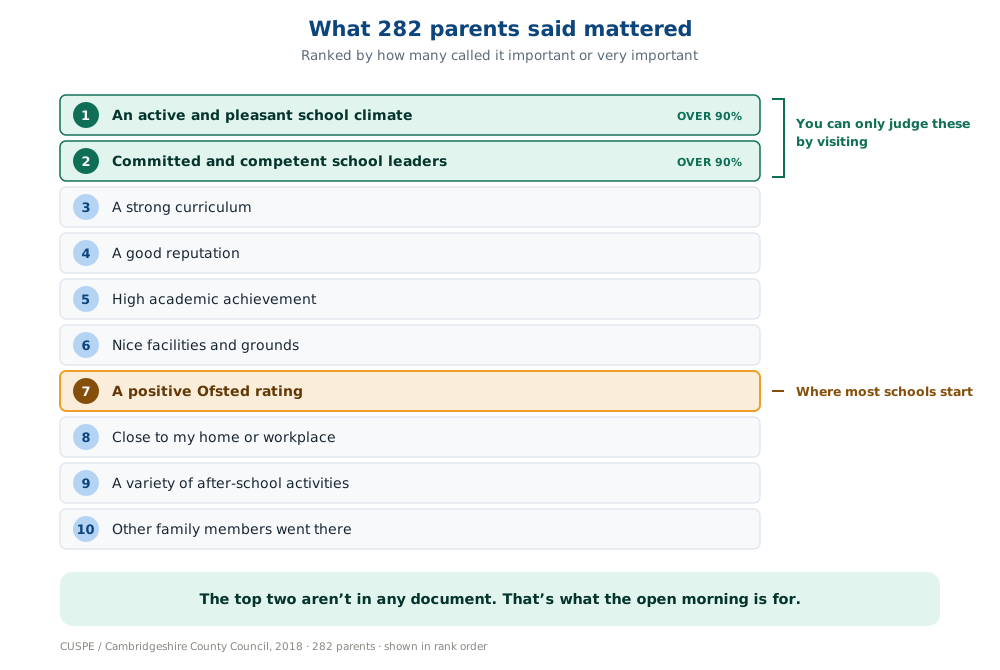
Here is the order in which parents rated the ten reasons they were given, by how many called them important or very important:
The school has an active and pleasant climate
The headteacher and other leaders are committed and competent
The school offers a strong curriculum
The school has a good reputation
Academic achievement is high
Nice facilities and grounds
A positive Ofsted rating
Close to my home or workplace
A variety of after-school activities
Other family members attend or attended
Over 90% of parents called the top two important or very important.
Most schools would have put Ofsted first and proximity second. Every governing body meeting about admissions I've ever heard about starts with the Ofsted grade.
That isn't to say Ofsted doesn't matter. It plainly does, and a school that goes into ‘Needs Attention’ will feel it. But it operates more like a threshold than a ranking. ‘Expected Standard’ or above satisfies most parents' concerns about standards, and they then spend their attention on the things the report can't tell them.
The two things at the top are the two things you can't publish
Look again at what came first and second. An active and pleasant school climate. Leaders who seem committed and competent.
There is no document that conveys either. No data set, no league table, no inspection report, no prospectus. A parent can only judge the atmosphere of a school by standing in it, and can only judge a head by meeting one.
Which explains the other half of the study.
Where parents get their information
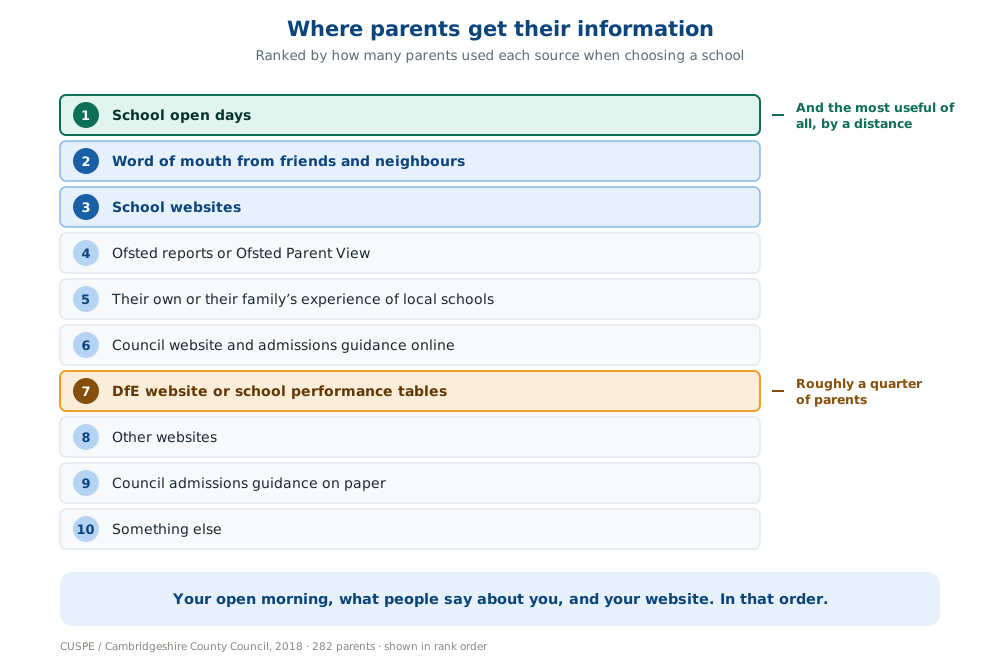
Asked which sources they used, parents named, in order: school open days, word of mouth from friends and neighbours, school websites, and Ofsted reports or Parent View. The Department for Education's own website and performance tables were consulted by about a quarter of them.
And when asked to name the three most useful sources, open days came first by a distance.
So the most valuable thing in your entire admissions year is the morning a family walks round your school. Not because open days are inherently magical, but because they're the only way a parent can get at the two things they care most about.
Everything else in the Fill Your Class Funnel — the posters, the advertising, the website, the film — exists to get a family to that morning. This study is the reason we build it that way round.
Two other things follow from that list.
Word of mouth came second, above your website and above Ofsted. What local parents say about you at the school gate and in the toddler group is doing more work than anything you publish. That's not something you can buy, but it is something you can build deliberately over a year.
Your website came third, ahead of Ofsted reports. Two-thirds of parents used it. Most school websites are built entirely for the families the school already has, which means two thirds of prospective parents are looking at a site that isn't addressed to them.
What happens when you make parents choose
The study did something clever. Having asked parents to rate every reason, it then asked them to pick their top three. Some things held their position and some collapsed.
Academic achievement went up. It rated fifth in the abstract but appeared far more often when parents had to commit to three.
Reputation and facilities went down. Both scored highly when parents were simply asked whether they mattered. Both fell away sharply when it came to naming a top three.
That gap is worth thinking about, because facilities are where schools spend money on marketing. The new library, the redone playground, the trim trail. Parents will tell you they're important. Almost none of them will tell you they're one of the three things that decided it.
The authors put it well: parents value the things that genuinely contribute to a child's development, and discount the things that only look like they do.
What parents wrote when nobody gave them a list
The most useful part of the report is the free text. Asked to add reasons of their own, parents wrote about:
a nurturing ethos and good pastoral care
development that's well-rounded rather than narrowly academic
good SEND support
small schools and small class sizes
strong policies on bullying and behaviour
leadership that actually responds to parents
cultural and linguistic inclusivity
links to the local community
wraparound care — before school and after school
Read that list next to a typical primary school homepage. Most of those things are either buried three clicks down or absent altogether, and several of them are the things the school is proudest of in private.
Wraparound care is the one I'd point at hardest. It's a practical, unglamorous, decisive fact for a working parent, it costs nothing to state, and it's very often not on the page at all.
The finding schools should be most uncomfortable about
Parents whose children are eligible for free school meals consulted fewer sources of information than other parents — 3.7 on average against 4.2.
That gap sounds small. Where it falls is the problem. The two biggest gaps, twelve percentage points each, were open days and Ofsted reports — the two sources parents rate as most useful. And none of the parents who reported making their own independent visits to schools, outside of open days, were parents of children eligible for free school meals.
The Sutton Trust found the same thing on a much bigger sample: working-class parents were three times more likely to be "limited choosers", using no more than one source of information, and four times less likely to be "hyper choosers" using five or more.
So the families with the least room to manoeuvre are getting the least information, and they're least likely to be at the event where the most useful information is.
If your entire admissions strategy is an open morning in October, you are systematically reaching the parents who were always going to find you and missing the ones who weren't. That is the argument for posters where people actually stand, for advertising that goes to a postcode rather than to people already following you, and for being in the building at a toddler group two years early.
It's also, incidentally, the right thing to do.
What we found at our own school
Our own conversations at the school in our case study matched the research almost line for line.
Existing parents talked about the small, family feel of the place and about it being inclusive. They mentioned the Good Ofsted, but as reassurance rather than as the reason. Several valued the one-form entry — every child known by every member of staff. Some liked that the school had been there two hundred years, which they read as stability.
The keyword research told us something the parents couldn't: a lot of local families were searching for childcare before and after school. The school had a breakfast club and an after-school club and had never made anything of either.
And the actual problem turned out not to be the school's reputation at all. It was that a large number of local parents didn't know the school existed, and those who did had never heard a single reason to consider it.
That's a very different problem from a bad school, and it needs a completely different fix.
What to do with this
Stop leading with Ofsted. State it, once, clearly. Then spend your energy on the things that outranked it.
Put the atmosphere of your school where it can be seen. You can't assert a pleasant climate; a parent has to feel it. That's what photography and film are for, and it's the whole argument for getting families through the door.
Put your head in front of people. The second most important factor in the study is a person. Make sure that person is the one running the tours, is on the film, and is visible on the website with a name and a face.
Say the practical things plainly. Wraparound care, times, costs, class sizes, SEND provision. These decide real decisions and they cost nothing to publish.
Stop spending on facilities marketing. Parents say it matters and don't act on it.
Go and find the families who don't come to open days. They're the ones who need you most and the ones you're currently missing.
Carve out time and resources to market your school. We know it’s a lot to do but it has a direct return on investment.
Where this sits
This is the research underneath everything else on this site. If you want the arithmetic on what it costs to get this wrong, that's what an empty Reception place costs. If you want the campaign that came out of it, that's the Fill Your Class Funnel.
And if you'd like to know which of the above your school is currently getting wrong, the Marketing Health Check takes fifteen minutes.
Frequently asked questions
What do parents look for when choosing a primary school?
In the Cambridge study of 282 parents, the two highest-rated factors were an active and pleasant school climate and committed, competent school leadership — both named important or very important by over 90% of parents. A strong curriculum, the school's reputation and academic achievement followed.
How much does Ofsted affect parents' choice of school?
Less than schools assume. A positive Ofsted rating came seventh out of ten factors. It functions more as a threshold than a ranking — a Good report satisfies most parents' concerns about standards, and they then judge the school on things the report can't tell them.
What is the most useful source of information for parents choosing a school?
School open days, named more often than any other source as one of the three most useful. Word of mouth came second and school websites third, both ahead of Ofsted reports.
Do parents choose schools based on facilities?
They say facilities matter, but when asked to name their top three reasons, facilities and grounds fell away sharply. Academic achievement did the opposite and rose. Schools consistently overspend on marketing their buildings.
What do parents mention that surveys don't ask about?
Given a free text box, parents wrote about nurturing ethos and pastoral care, SEND support, small class sizes, bullying and behaviour policies, leadership that responds to parents, community links, and wraparound childcare before and after school.
Which families are least likely to attend a school open day?
Parents of children eligible for free school meals consulted fewer information sources than other parents, with the largest gaps on open days and Ofsted reports. The Sutton Trust found working-class parents were three times more likely to use no more than one source of information. A school relying solely on an open morning systematically misses them.
Ian Clifford is the co-founder of School Marketing Works and has been running admissions campaigns for UK schools since 2019, including the one documented in our published falling school roll case study.
Source: Bence Börcsök, Erin Cullen and Yue-Yi Hwa, Cambridgeshire Policy Challenges: Parental Preference of Schools, Cambridge University Science and Policy Exchange, 20 September 2018. Also cited: Rebecca Montacute and Carl Cullinane, Parent Power 2018, The Sutton Trust, September 2018.