
Quick answer: Read this site end to end and it adds up to a booking page, ten tour slots, an open event, a poster run, a Facebook post, a small ad budget, photographs of your own children, a follow-up sequence and somebody asking every family how they heard about you.
That is a lot, on top of running a school. We ask it anyway, because in a place where parents have a genuine choice between schools, the alternative costs more — three empty Reception places cost £107,415 over the seven years that cohort would have been with you. You can do all of it yourself; it's manageable,
it just competes with everything else. We charge a little more than one pupil's funding to do it for you. We can't always promise it works. We can promise it gets more families through your door. Then you make them love your school.
The whole list, honestly
If you've read your way round this site, here's what we've asked you to do.
Build a page where a parent can book a visit at half past nine at night. Put ten tour slots across the autumn at mixed times and different days. Hold an open event while the school is open, before Christmas, avoiding the dates your neighbours have picked.
Make a poster and spend an afternoon getting it into fifty places where parents of four-year-olds actually go. Post it on Facebook and share it into the local groups. Run a small advertising budget, aimed properly. Get photographs of your own children that don't look like the newsletter.
Understand what makes people choose your school and then fix the pages on your website that prospective parents actually read. Then follow up everyone who visited, twice, and again in the first week of January.
And ask every single family how they heard about you, so that next year you know which half of it worked.
We're aware of how that reads in October, when you're two staff down and something else is on fire.
Why we ask it anyway
Because the alternative isn't standing still. It's a slow decline that costs more every year, and it starts invisibly.
A Reception class that takes 27 against a published number of 30 is at 90%. Nobody calls that a crisis. It gets described in a governors' meeting as nearly full.
Those three chairs cost £15,345 in their first year. Followed through to Year 6 — because a child who doesn't join in Reception doesn't join in Year 1 either — they cost £107,415. And schools with a falling roll are rarely three short once. Three short every year, once it's worked through, leaves you permanently 21 pupils below capacity: £107,415 a year, indefinitely. The full arithmetic is here, But in short, if you're three pupils short, Every year from reception to year six and across the school you'll eventually be 21 pupils short in that time. That's an unpaid budget of £429,660.
That's a lot of money you could have put to good use.
None of that is a marketing budget. It's teaching assistants. It's whether you keep two Reception classes. It's whether you replace the teacher who leaves or absorb the gap.
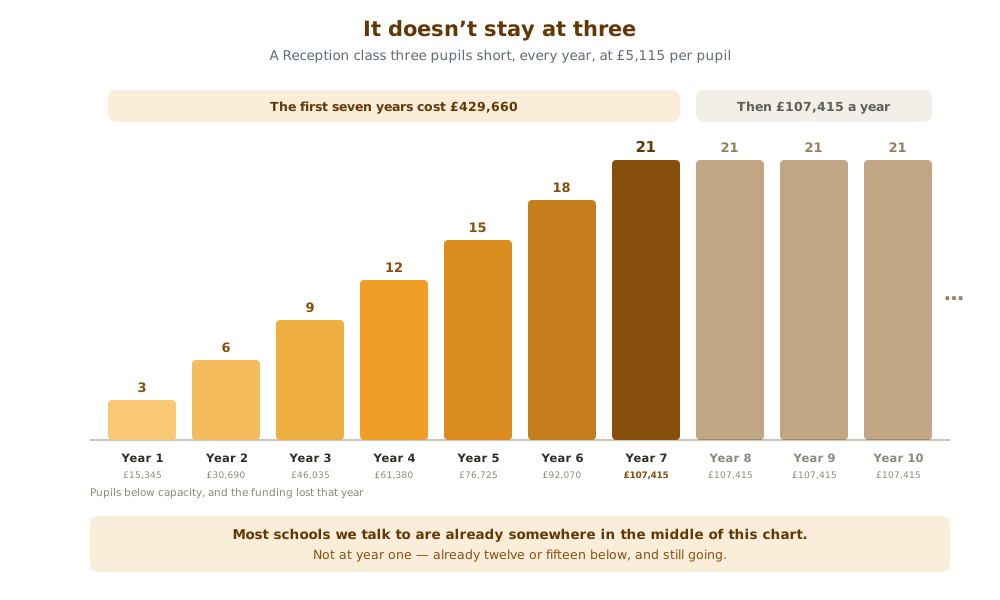
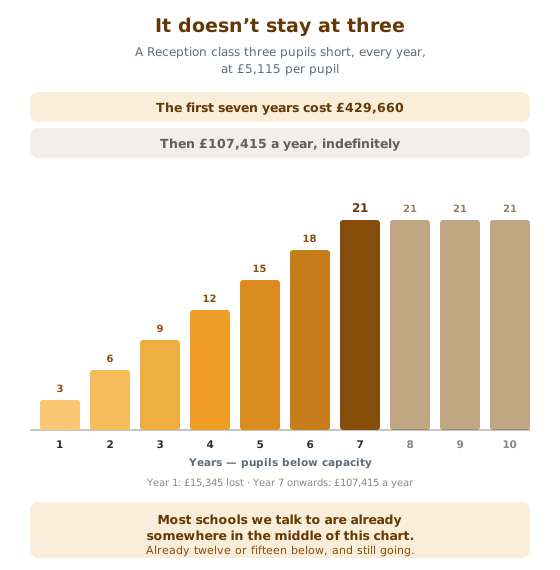
That's why the list is as long as it is. Every item on it is cheaper than the thing it prevents.
Yes, you could do all of it yourself
We should be straight, because you'd work it out anyway.
Everything we describe is doable by a school on its own. None of it is complicated. We publish the entire method — the posters, the ads, the visits, the open event, the follow-up — precisely so a school that wants to do it alone can.
It is manageable. It is not free.
What it costs you is attention, in the term you have least of it. The poster run needs an afternoon. The ads need setting up and then checking. The booking page means going back and forth with whoever looks after your website. The January emails need writing and actually sending, in January.
None of that is hard. All of it competes directly with running your school and looking after the children already in it.
That's the whole reason we exist. Not because it's difficult — because it's relentless, and it lands on people who already have a job.
What it costs to have us do it
A little more than one pupil's funding for the year.
We put it that way because it's the only unit that makes the decision legible. Bring in three children and it has paid for itself three times over, and goes on paying for seven years. Bring in one and you've pretty much broken even. Bring in none and you've spent roughly what one empty chair was costing you anyway.
It's also the honest way to put it to governors, who will reasonably ask.
What we can and can't promise
We can't promise it will work for your school. Nobody honest can. Too much depends on things nobody controls — how many four-year-olds live near you this year, what the school down the road does, whether it turns out to be a normal year.
What we can promise is that it's the single most effective way to get more parents through your door. More families visiting, more of them seeing the school properly, more arriving already knowing what you're about.
After that it's your job. Persuading them, making them welcome, being the school they want for their child — that isn't marketing and we couldn't do it if we tried. What we can do is make sure the families who would choose you actually find you first.
Which is why we spend as much time on the visit as on the advertising. Getting somebody to book is the easy half.
When we'd tell you not to bother
We try hard not to take on schools we don't think we can help. A year of work with nothing at the end is no use to anybody.
If there aren't enough children. Some schools are under-recruiting because the local birth rate has fallen and the families aren't there. Our research into English primary occupancy found that schools with no other primary within 2km are the most likely of all to be under-filled — and no amount of advertising creates children who don't live nearby. Different problem, different answer.
If the issue isn't visibility. Marketing makes a school visible. It cannot make a school into something it isn't. If there's a genuine local reputation problem, doing all of this surfaces it faster rather than fixing it — more families look, and reach the same conclusion sooner.
We think Ofsted is over-weighted as a reason parents choose a primary; word of mouth and how a place feels matter more. But a school people have heard of and decided against is in a different position from one they've never heard of, and only the second is a marketing job. Reputation can be rebuilt. It takes longer, it starts inside the school, and it isn't something we can sell you. But our consulting service can help with that. It costs less and plays out over a longer period.
We'd rather say that at the start than take a year's fee and tell you in July. That's what the Marketing Health Check is for.
The parts that are a nuisance, honestly
We do as much of the work as we possibly can, and some of it still has to involve you.
Your website. There'll be back-and-forth with whoever looks after it. If that's a specialist school website company, changes can take time and sometimes cost money. It's the most common thing that slows a campaign down.
Ad account setup. Meta's business tools are genuinely awkward the first time. Once it's running it's fine, but the setup is a fiddle and needs somebody at the school with the right permissions.
Photographs. If you haven't got usable pictures of your own children, we'll need an hour and a consent list.
And the follow-up needs a human at your end who'll send the emails and take the calls. We can write them. Somebody in your office has to be the person at the other end.
We say all this before a school signs, not after.
Where this sits
The whole method is in the Fill Your Class Funnel, and the campaign we've published in full is our case study, which we updated with what’s changed over the last seven years of doing this.
We know it's hard
We know it's hard finding the time and the people to do this yourselves, on top of everything else a term contains.
We know it's hard justifying the money to governors, particularly in a year when the budget is already tight and the thing you're buying is a maybe.
But we also know it's really, really hard running a school for years with a falling roll that you feel you can't fix.
That's why we do what we do.
Frequently asked questions
Is marketing a school actually worth the money?
It depends what's causing the shortfall. Where there are children in the catchment and parents are choosing between several local schools, a proper admissions campaign reliably increases the number of families who visit. Where the shortfall is demographic, or the school has a genuine reputation problem, marketing won't fix it and we'd say so.
How much work is school admissions marketing?
Realistically: a booking page, around ten tour slots across the autumn, one open event, a poster run of an afternoon, a Facebook post, a small ad budget, decent photographs, and a follow-up sequence including a January reminder. None of it is complicated. All of it competes with running the school.
How much does school marketing cost?
Ours is a little more than one pupil's annual funding. If the work brings in three children it has paid for itself three times over, and those children stay for seven years.
What does a three-pupil shortfall in Reception cost?
£15,345 in the first year at the 2026–27 minimum rate, and £107,415 across the seven years that cohort would have been in school. If it recurs annually, the school ends up permanently 21 pupils below capacity — £107,415 a year.
Can a school do its own admissions marketing?
Yes, and we publish the whole method so it can. What it costs is attention in the term you have least of it.
When is marketing not the answer?
When there aren't enough children locally, or when the school has a reputation problem rather than a visibility one. Marketing surfaces a reputation problem faster; it doesn't fix it.
Can you guarantee more applications?
No, and nobody honest can. What a good campaign reliably does is get more families through the door. Converting them is the school's job.
Ian Clifford is the co-founder of School Marketing Works and has been running admissions campaigns for UK schools since 2018, including the one documented in our published falling school roll case study.