
Quick answer: Run both. Around ten bookable tour slots spread across the autumn term, deliberately mixed — some mornings, some afternoons, spread across different days of the week — plus one or two open events held before Christmas. Individual tours remove the "we can't make that date" problem, which is the biggest single reason families never visit at all.
An open event does something no tour can: it gets everybody in the building at the same time, so a prospective parent can see that other people want your school. Check what the schools you compete with have scheduled before you fix your own dates.
What we had half-right
For most of the time we've been doing this, our schools ran individual tours and nothing else.
The logic was sound, and it still is. A parent picks a slot that suits them, turns up, and gets an unhurried walk round with the head. Plenty of options means that nobody has to take a morning off work to make a single fixed date. Nobody has to ask their question in front of eleven other families. It converts, it's easy to say yes to, and it solved the most obvious problem we could see — that a school would run one open morning in October and simply never meet the families who couldn't be there that Tuesday.
What we didn't reckon with is what you lose by never getting everybody in the building at once.
So, for a couple of years now, we've been advising our schools to run open events as well as the regular tours. Every one of them has found it worth doing. This is what we changed and why.
What an individual tour actually does
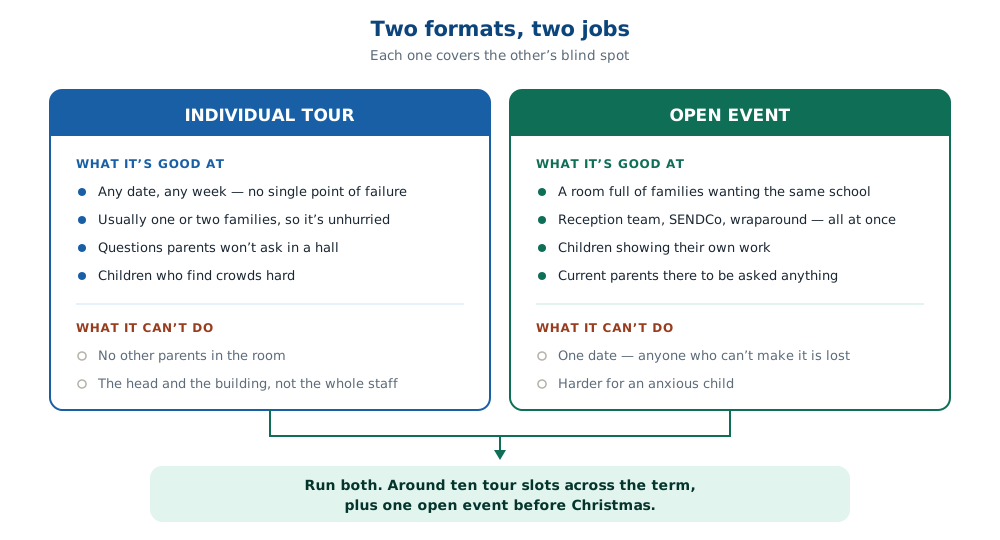
It removes the date problem. This is the big one. A single fixed event is a single point of failure — one date, one time, and every family with a clashing work shift, a hospital appointment or a toddler who naps at eleven is lost, silently, without ever appearing in your potential applicant numbers.
It's genuinely unhurried. We cap tours at six families. In practice it's never six. Most tours are one or two families, occasionally three, and four is unusual. So while the cap says small group, what most parents actually get is close to a private appointment with the head — half an hour, at their pace, going wherever their questions go.
It removes the embarrassment. This matters more than most schools realise. Parents have questions they will not ask in a hall — about behaviour, about how a struggling reader is supported, about whether their child will actually be looked after. In a group they nod along and go home with the question unanswered. One-to-one they ask it, and you get to answer it.
It suits children who find crowds hard. A busy open event is genuinely difficult for an anxious child or a child with additional needs, and for their parent it can be the thing that decides them against you — not because of anything about your school, but because the visit itself was awful. A quiet slot at two in the afternoon is a completely different experience.
And it's a small decision. A parent browsing your website at half past nine at night can pick a date that works for them and book it in about forty seconds. That's much easier to say yes to than committing a specific one-off morning three weeks away.
What an open event does that a tour can't
Other people
A prospective parent standing in a busy hall can see that other families want this school. That's not something you've told them, which is exactly why it registers — you can write "a happy, welcoming school" on every page of your website and it will never do what a full room does.
There's a buzz to it that a Tuesday afternoon walk round doesn't have, and it changes what a family takes away.
The rest of the school, in one place
A tour is the head and the building. Good, essential even, but still only partial.
An open event lets you put the Reception team, subject leaders, the SENDCo, the wraparound care team and the office staff in one room at one time, all available to be asked things. Arranging that for twelve separate individual visits is impossible. Arranging it once is straightforward.
You can also have children showing their work, and the head can speak properly to everyone at once rather than repeating the same five minutes twelve times.
One thing a couple of our schools have done
A couple of the schools we work with have had two or three parents of children already at the school — Reception, or Year 1 or Year 2 — simply present on the day. Not presenting, not standing up, not part of the programme. Just there, so that a prospective parent who wants an unbiased answer can get one. The head mentions it once, in passing: we've got a couple of parents here if you'd like to talk to them.
Two honest problems with it. It has to be genuinely hands-off — the moment it looks as though the school has briefed people on what to say, it's worth less than nothing. And you need parents who can actually be there, which is easier for a daytime event, since they're on site at drop-off anyway.
If you've got a good relationship with a parent or two and it feels comfortable, it's worth doing. If you'd have to engineer it, leave it.
And it isn't either/or
It's early days and we don't have solid data to prove it. But every school we've advised to run both has found both valuable, and the pattern we keep seeing is that plenty of families do both — the ones who came on a tour turn up to the open event as well.
They come because they know they'll see more and learn more. But they arrive already having had a taste of the school, with a sense of familiarity, and that seems to matter. Our empirical evidence is that running the two together delivers more than either on its own.
You'll need to decide what kind of event it is
There's one decision to make before anything else, and it isn't the date — it's whether the event happens while the school is open, at the end of the day, in an evening, or at a weekend.
They are four different events, not four dates for the same one. During the school day, parents see children in lessons and staff behaving normally, which for a primary is the evidence they're actually looking for. In an evening you'll reach more working parents but you're showing an empty building. A weekend brings a further problem, because staffing it comes out of your directed time budget.
We've come to think almost all primaries should hold theirs while the school is open — and use the tours, at mixed times, to reach the parents who can't make a weekday morning. We've set out the reasoning, along with what to put on and what parents are actually looking at, in our guide to running a school open event.
Make that choice, get the date in the diary, and you're getting most of the benefit. The rest is detail, and it can wait until you've got the thing booked.
It's also important to make it clear whether prospective children should attend the tours or the open event. Often parents aren't sure and don't want to feel awkward if theirs is the only child present. So make a decision, clearly detail it on your booking page, and if you are open to children being there, then make sure you have something for them to do at an open event. Usually child will simply do the tour with their parent, but for the half hour where you're presenting and discussing the school with a large group at an open event, you should have any prospective children in a classroom doing story time with a TA or something similar.
At secondary schools it's almost de facto for the prospective children to come to the open event. At primary schools, it seems less common, but we think it's important to accommodate parents of young children by clearly stating that you're happy for their children to come with them.
There's little downside from the school's perspective and you're used to having four-year-olds running around creating havoc anyway!
What we now advise
Around ten tour slots, deliberately mixed
Not ten identical Tuesday mornings. Mixed.
Some at ten in the morning, some at two in the afternoon. Some on a Monday, some on a Wednesday, some on a Friday. Spread across September, October, November and the first week of January.
The mixing is the point. Every fixed pattern excludes somebody. A school that only offers ten o'clock slots has quietly decided not to meet parents who work mornings, and it will never know how many that was. Vary the day and vary the time and you catch most people's schedules without doing more visits than you were doing anyway.
Ten is more than most schools manage. It's less work than it sounds, because a tour with two families in it takes about the same effort as a tour with one.
If you can do more, absolutely do. You’ll find that many don’t get any bookings at all, so you don’t end up running them. But you can’t know the slots that people will pick. St Andrew’s often has twenty across the Autumn term and maybe twelve or so end up with one, two or three families. That’s pretty much bang on for what you want.
One or two open events, before Christmas
One is usually enough. Two is fine if you've got the appetite, but for most primaries it’s not necessary. Pour all your effort into the one and only consider a second if your school is more than one Reception class or if your marketing of the first one flailed for some reason.
Hold them before Christmas. By the time you come back in January you have roughly two weeks before applications close, and those weeks are for mopping up — chasing the families who visited and haven't applied, running the "how to apply" messaging, answering last questions. An open event in the second week of January is too late to change anybody's mind and it competes with the deadline for attention.
After Christmas, put on another couple of tour slots instead. Cheap, flexible, and they catch the late deciders who have suddenly noticed the deadline is real.
Check what your neighbours are doing first
Before you fix a single date, find out what the schools you compete with have scheduled. You know perfectly well which schools those are.
Look at their websites, their newsletters, their Facebook pages. And whatever else you do, don't put your open event on the same day as theirs. A family choosing between two schools will go to one of them, and if the dates clash you're relying on a coin toss to decide which.
It costs twenty minutes to check and it's the cheapest thing in this entire article.
Who runs the tours
At St Andrew's, the head runs them. That's the right answer where you can manage it — the person a parent most wants to meet is the person who'll be in charge of their child, and half an hour with them is worth more than any brochure.
If your head genuinely doesn't have ten mornings and afternoons to give, the honest alternatives are a deputy or assistant head who can speak with authority, or fewer slots run properly rather than more slots run by whoever happens to be free. What doesn't work is handing tours to somebody who can't answer the questions parents actually ask, because the unanswered question is the thing they'll remember.
What this looks like in practice
St Andrew's in Lambeth — the school in our published case study — has run a weekly bookable tour system for years. Their tour booking page lists every available date as a button, capped at six bookings each, with the school's film and a 3D walkthrough on the same page.
Every year they have a run of morning slots and afternoon slots to give every family a window they can make. And one open event in mid-November — held during the school day, so that visiting families see the place working rather than an empty building after hours.
That's the shape we'd now recommend to most primary schools: a lot of small, flexible, easy-to-book visits, plus one occasion when everybody's in the building together.
Your booking page needs to say both
This is the bit that gets missed. If you add an open event to a school that has always run tours, and you bolt a date onto the bottom of the page, most parents will read it as either/or and pick one.
Say it plainly instead. There are two ways to come and see us, and plenty of families do both.
It's a sequence worth encouraging. A parent comes on a quiet individual tour in October, likes what they see, and brings their partner and their child to the open event in November to confirm it. Or the reverse: they come to the open event, get a feel for the place, then book a tour to ask the questions they didn't want to ask in a hall.
Add the 3D virtual tour and the school film to the same page and you've covered the family who can't get to either yet — and they're often the ones who book once they've watched.
Can you tell which one worked?
Only if you set it up beforehand, and it isn't difficult.
Use separate booking confirmations for tours and for the open event, each landing on its own thank-you page, so your analytics separates them without you doing anything.
Ask on the form. "How did you hear about us" at the point of booking, kept somewhere central rather than in somebody's inbox. More on the mechanics in our post on the booking system.
Take a register at both, and record which families came to which. After one full season you'll know whether the families who did both were more likely to apply than the families who did one — which is the number we'd all like to have and nobody currently does.
Then ask at the point of application. It's the only way to catch the parent who came in October, decided in December and applied in January without ever clicking anything.
Where this sits
Visits are the conversion stage of the system we use to fill school classes. Getting seen locally comes first — posters, local advertising, and everything in the Fill Your Class Funnel. None of it matters if there's nowhere obvious to book once a parent is interested.
If you're not sure whether visibility or conversion is your problem, the Marketing Health Check works that out before you spend anything.
Frequently asked questions
Should a school run tours or open days?
Both. Around ten bookable individual tour slots spread across the autumn term, mixed across different days and both mornings and afternoons, plus one or two open events held before Christmas. Tours remove the "we can't make that date" problem; an open event gets everybody in the building at once.
How many open events should a primary school hold?
One is usually enough and two is fine. More than that and you're spending senior staff time on repeat performances that would be better spent on additional tour slots.
When should a school hold its open event?
Before Christmas. January is only about two weeks long before primary applications close on 15 January, and those weeks are better spent following up families who have already visited. Check neighbouring schools' dates and avoid clashing.
Should a primary open event be during the school day or in the evening?
During the school day, for most primaries. Parents see children in lessons and staff behaving normally, which is the evidence they're looking for. Use bookable tours at mixed times to reach parents who can't make a weekday.
How many families should be on a school tour?
We cap ours at six, but in practice most tours are one or two families. That's part of why they work — the parent effectively gets a private appointment with the head.
Should current parents attend an open event?
A couple of the schools we work with have two or three parents of children already at the school simply present, so prospective parents can get an unbiased answer if they want one. It only works if it's genuinely informal and the parents aren't briefed on what to say.
Why do individual tours work for some families?
They can pick a time that fits around work, they aren't asking sensitive questions in front of other parents, and they suit children who find busy environments difficult — including anxious children and children with additional needs.
What does an open event do that a tour doesn't?
It lets a prospective parent see that other families want the school, and it lets you put the Reception team, the SENDCo and the wraparound care team in one place at one time. Neither is possible on an individual walk round.
Can parents attend both a tour and an open event?
Yes, and it's worth encouraging. Many families use one to get a feel for the school and the other to confirm it or to bring a partner. Say so on your booking page, or parents will assume they have to choose.
Ian Clifford is the co-founder of School Marketing Works and has been running admissions campaigns for UK schools since 2018, including the one documented in our published falling school roll case study.