
Quick answer: If you're a primary school, hold it while the school is open, and show the things a four-year-old's parent is actually worried about — lunch, the toilets, what happens when a child cries, who'll notice if theirs is quiet. Not the IT suite. An open morning lets you demonstrate all of that instead of asserting it, which is the one thing an evening presentation cannot do. Hold it before Christmas, keep the head's talk under ten minutes, decide in advance whether children are welcome, and do the follow-up.
Most advice about open days is about getting people through the door. This is about what happens once they're inside, which is the part that decides whether they apply.
We've written separately about whether to run tours or open events at all — the short answer is both. This assumes you've decided to run an event and covers how.
One thing first. You know your school and you're better placed than we are to decide how to run your day. We're a marketing company; what we see is what our schools do, what the numbers say afterwards, and what parents tell us. Treat the rest as things worth thinking about.
Your open event is not the start of the funnel
By the time a family walks through your door they’ve read your Ofsted report, been over your website, looked at your photographs and quietly checked what local people say about you on Facebook. They have already shortlisted you.
The open day's job is to let families test the online version of the school against the real one and decide whether the promise feels credible.
You are not building awareness. You are being checked.
And it is very hard to fail that check when the school is full of children.
What a Reception parent is actually buying
Here's where most primary open days go wrong, and it isn't the timing.
Schools showcase what they're proud of. The new IT suite. The forest school. The results. The Ofsted grade. The trophy cabinet, if there is one.
A parent choosing a Reception place is thinking about almost none of that (well, maybe the forest school - a genuine asset!) They are thinking about whether their four-year-old will be safe, looked after and happy. That's the purchase. Everything else is detail they'll get to later, if at all.
And the questions underneath it are far more concrete than schools expect.
Safety, as a parent means it. Who's on the gate and how does it work. Who can collect. What happens if my child has an accident and wets themselves — genuinely one of the biggest unspoken fears a Reception parent has, and almost nobody addresses it. Whether four-year-olds share a playground with Year 6. How medicines and allergies are handled.
Lunch. Can a four-year-old manage a tray. Will someone cut things up. What happens if they don't like anything. Show parents the hall at lunchtime and you've answered a question they were too self-conscious to ask.
Settling in. What September actually looks like. Staggered starts. Who the one adult is who'll know their child. What happens when a child cries at the door in week two — because they will.
Being noticed. Parents of quiet children carry a specific worry: that a shy child will simply be overlooked in a class of thirty. If you can show how you spot the child who isn't asking, you've spoken directly to something they're carrying and haven't voiced.
Almost none of that can be asserted. "We're a caring school" is what every school says, and parents have heard it four times already this term. All of it can be shown, in an hour or so, if the school is open.
Which is the real argument for a daytime event. Not the atmosphere in the abstract — the fact that the specific things a parent is worried about are visible only when children are in the building.
And what they're looking at while you do it
Published advice for parents is useful to schools for one reason: it tells you the checklist walking into your building.
The Good Schools Guide tells parents to look at whether displayed artwork reflects a range of abilities rather than only the best work. To watch how teachers interact with pupils and whether there's energy in the room. To notice whether children are confident enough to speak up. To look at the books on the shelves and the resources children have to hand, because those details reveal the ordinary day.
It also tells them to look at the other parents and ask whether their family would fit in.
And it's honest with them that an open day shows a school at its best and isn't a normal day. They know they're seeing a version. They're hunting for what couldn't have been arranged.
So:
Displays: range, not highlights. A wall of immaculate work from six children reads as a school with six good children.
Children talking to strangers. If your pupils are confident and courteous with visitors, that's the most persuasive thing in the building.
The ordinary stuff. Book corners, resources, the corridor nobody planned to show anyone.
The Reception team front and centre. The person a parent most wants to meet after the head is the adult who'll actually be with their child every day. Put the Reception teacher and TA where families can talk to them, not in a classroom at the end of the route.
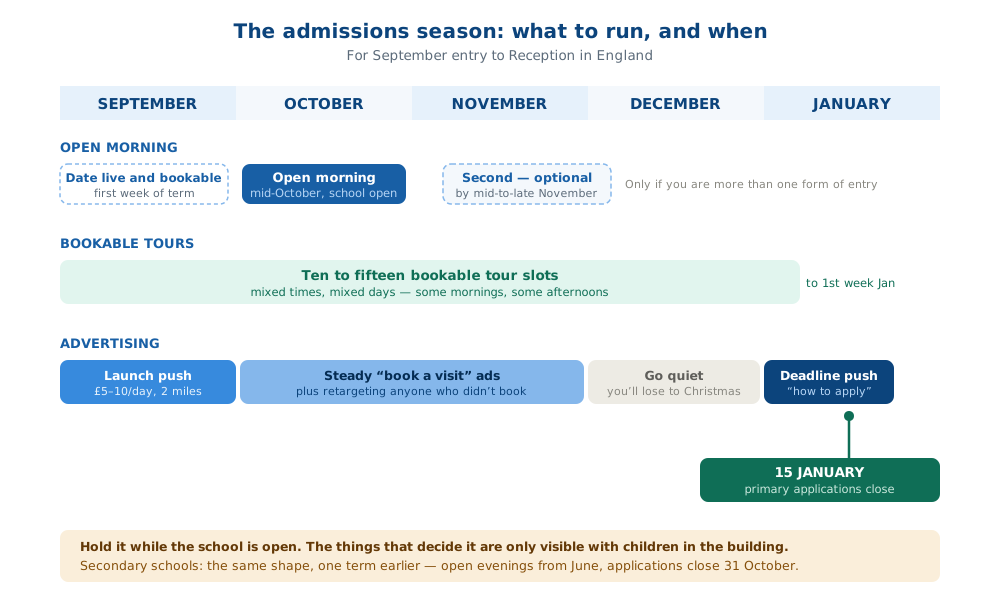
For a primary, hold it while the school is open
Everything above points one way, and it's more clear-cut than most timing advice.
What a primary parent needs to see requires children in the building. They aren't evaluating science labs. The only evidence that a school is warm is watching an adult speak to a child who's struggling — and you can't stage that.
You're being checked, not introduced. A parent who has spent three weeks on your website is looking for what you couldn't have arranged for their benefit.
A primary's strengths are people, not facilities. Secondary schools have things to show off in an empty building. You have atmosphere, and atmosphere needs children in it.
Your own pupils are the most persuasive thing you own. Year 6 leading families round or answering questions does more than anything an adult says, and it's good for them too.
"But working parents can't come"
This is the objection that pushes schools into evenings, and it's a real one. It's also already solved.
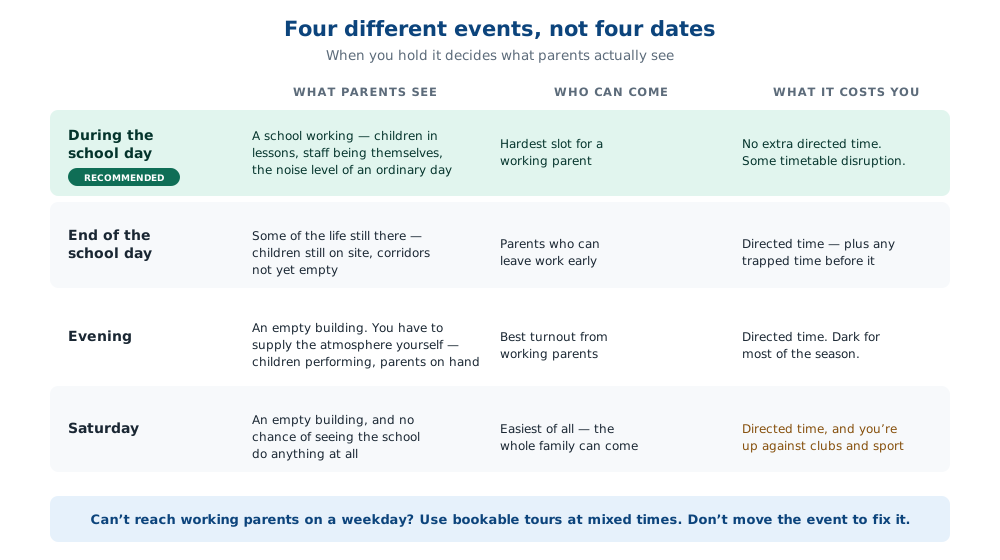
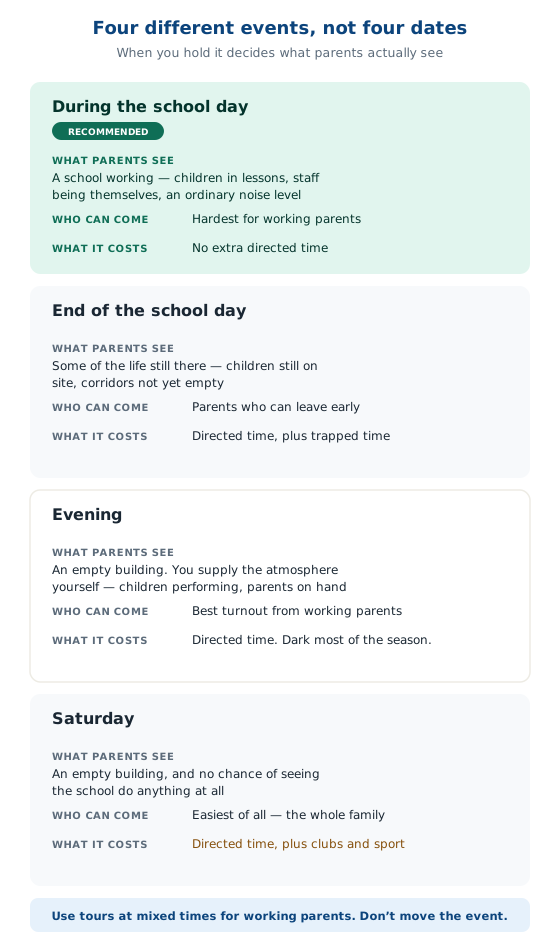
The answer isn't to move the event. It's to run bookable individual tours across the term at mixed times — some mornings, some afternoons, different days of the week — so a parent who can't make your open morning has ten other ways in.
Move the event to an evening and you give up the one thing that made it worth running, to solve a problem the tours have already dealt with. Keep both, and each does the job it's good at.
The practical constraint, which catches people out
There's a cost to going outside the school day that rarely comes up until it's too late.
Teachers working under the School Teachers' Pay and Conditions Document have a directed time budget — 1,265 hours a year, across 190 teaching days and five non-teaching days — and the NEU's guidance explicitly lists "parents' meetings and open evenings" among the things that must come out of it. So an evening or weekend event is paid for somewhere else in your timetable. Even a twilight start can bring "trapped time" into play, where the gap between the end of school and the start of the event is too short for staff to go home and counts too.
Some academies and free schools operate different working time provisions, so check contracts of employment.
And the timing of the decision matters: the directed time calendar is set at the start of the academic year in consultation with the recognised unions. If you decide in October that you'd like a November open evening, you may already have missed the moment to schedule it cleanly. Put next year's event in the calendar before next year starts.
Weekends carry both problems at once — an empty building and the directed time cost — which is why they're common in the fee-paying sector and rare in the state one.
Whichever you choose
Hold it before Christmas. You come back in January with about two weeks before primary applications close on 15 January, and those weeks are for following up families who've already visited.
Check what your neighbours have scheduled. If you clash with the school you're competing against, you're relying on a coin toss.
Secondary is a different problem
Secondary schools are pitching to hundreds of families at once on high-stakes decisions about GCSE options, science labs and drama studios. A large open evening in September or October is a volume exercise — some attract over a thousand people, at which point nobody gets a personal feel for anything.
So the sector standard is a hybrid: the big evening for reach, then bookable small-group daytime mornings in the following weeks, so seriously interested families can check whether the evening was true.
Same principle as the primary advice, arrived at from the other direction. The evening builds the shortlist; the daytime visit is where it's tested. And the purchase is different — a secondary parent is buying capability and opportunity, a primary parent is buying care.
The running order
Before
Open bookings early and keep records somewhere central — see the booking system post.
Send a reminder two or three days before, with parking, entrance and how long it'll take.
Decide about children attending and put it clearly on the booking page (discussed and suggested in our ‘event or tours’ post here - /school-tours-or-open-days/)
Brief the staff — where to be, who covers what, who to hand a hard question to.
Brief whoever's on the door. The most damage is done in the first thirty seconds.
On the day
A warm, organised arrival. Someone who knows their name, a register, no queue.
A short talk from the head. Ten minutes at most.
The school, doing what it does — including lunch, if you can time it that way.
People available to be asked things — the Reception team, the SENDCo, wraparound care, the office. Getting all of them in one place at one time is most of the reason to run an event rather than only tours.
Something for the visiting children, if they're coming.
Time to talk. The conversations at the end are where parents ask what they actually came to ask. Don't schedule them out.
After
The follow-up, below, because it's where nearly everyone stops.
The head's talk
Ten minutes is plenty. Five is often better.
Parents didn't come for a presentation. They came to get a feeling about the person who'll be in charge of their child. The talk exists to give them that feeling — the facts can go on a sheet they take home.
Put real thought into it rather than winging it. Warmth beats polish. One or two concrete things — a particular child, something that happened last term — do more than any list of achievements.
And answer at least one of the worries above out loud, because most parents won't ask. Some of you are wondering what happens if your child has an accident, or won't eat their lunch, or cries at the door in the second week. Here's what we do. That is worth more than five minutes on the curriculum, and almost no head says it.
Say honestly what you're working on, too. A head who names a weakness and what they're doing about it is more convincing than one who claims everything is excellent, and parents have heard the second version at every school they've visited.
Then stop talking and let them look.
Who else should be there
Your own pupils. The most under-used asset in the building.
The Reception team. See above — after the head, the most important people in the room.
Current parents. A couple of the schools we work with have two or three parents of children already in the school — Reception, Year 1 or Year 2 — simply present. Not presenting, not standing up. Just there, so a prospective parent who wants an unbiased answer can get one. The head mentions it once: we've got a couple of parents here if you'd like to talk to them.
It only works if it's genuinely hands-off. The moment it looks briefed it's worth less than nothing. Getting them there is easier for a daytime event, since they're on site at drop-off anyway.
The SENDCo. Disproportionately important. A parent whose child has additional needs, or who suspects they might, won't raise it in a group — but they will look for the person they could ask, and whether that person exists tells them something.
The office staff. First voice on the phone, first face at the door.
Children of prospective families
Decide, and say so on the booking page. The silence is what causes the problem.
Parents genuinely don't know whether they're meant to bring their four-year-old, and plenty worry about turning up with a child and being the only one who did.
Three ways schools get this wrong, all from parents describing real visits:
- They wouldn't let me bring him. A flat no with no reason reads as a rebuff, and it sticks.
- They let me bring him but seemed surprised. Worse than a clear no — it tells a parent they've broken a rule nobody told them about. One described a school looking at her as though she had two heads for arriving with her child.
- They let me bring him but there was nothing for him to do. The parent spends the visit managing a bored child, takes in nothing, and remembers you as the school where it was hard work.
Three ways to word it. Pick one and give a reason — a rule without one reads as an instruction.
- Children are very welcome. We'll have a Reception classroom open with the toys out and a teaching assistant on hand, so you can look round and ask your questions while they play.
- We'd suggest coming without your child if you possibly can — there's a lot to take in and it's easier to ask what you actually want to ask. If childcare is difficult, please don't let that stop you: bring them, or book an individual tour instead, which is much easier with a little one in tow.
- Bring your child or come on your own — both are completely fine. If you bring them we'll have somewhere for them to play. If you'd rather concentrate, plenty of parents come without and nobody will think anything of it.
That last clause matters. It removes the social risk, which is what parents are actually worried about.
What to lay on costs almost nothing. Story time with a teaching assistant. Toys out. A drink and a biscuit. Someone keeping an eye while parents talk to the head. One school ran story time during the head's talk then let children play in the playground for an hour afterwards while staff stayed to chat — and that unstructured hour was what the parent remembered.
There's an argument for welcoming them, too: a parent watching how your staff are with their child is getting the strongest possible answer to the safety-and-warmth question. That's difficult to arrange and impossible to fake.
Ask on the booking form whether they're bringing children, so you know the numbers.
And there's a fair case for saying no. Parents make it themselves: you can't concentrate while managing a small child, and a four-year-old who falls for the school with the good climbing frame doesn't understand you can't simply choose it. Saying no is fine. Saying nothing isn't.
Either way, the child's real visit comes later, at the stay-and-play once a place is confirmed — see pre-Reception events.
What to capture while they're in the building
The highest-intent moment of your admissions year, and most schools record a headcount.
A register. Who booked, who came, who didn't. The no-shows were interested enough to book — that's a list worth having.
"How did you hear about us?" at booking and again on the day for walk-ins.
The questions you get asked. Three families asking the same thing means your website isn't answering it — and it probably belongs in the head's talk next year.
A next step, offered while they're standing there — a tour date, a call with the head, or the application deadline on a card in their hand.
The follow-up almost nobody does
Most schools send one thank-you email. Many send nothing.
Within a day, a thank-you that answers the questions that came up — the real ones, including those asked by other families, because if one person asked it, five wondered.
A fortnight later, something useful rather than promotional. A photograph from the day, the school film, the answer to something you've since looked up.
First week of January, the one that matters: applications close on 15 January, here's how to apply, here's who to ring if you're stuck. To everyone who visited and hasn't applied — which you can only know if you kept the register.
And offer a second visit. Some families need to come twice, or bring a partner who couldn't make it.
How to tell whether it worked
Bookings, attendance and no-shows, separately. Low bookings is a visibility problem — posters and local advertising. Good bookings and poor attendance is a reminder problem, which is easy to fix.
A separate thank-you page for event bookings and tour bookings, so your analytics splits them without you doing anything.
Then ask at the point of application — did you visit us, and when? The only way to catch the family who came in November, decided in December and applied in January without clicking a thing.
After one full season, you'll know something almost no school knows: whether families who visited applied at a higher rate than those who didn't.
Where this sits
The visit is the conversion stage of the system we use to fill school classes — set out in the Fill Your Class Funnel and documented in our published case study.
And since parents arrive having already read everything you've published, what's on your website is doing more of this work than your open day is.
If you're not sure whether your problem is too few families visiting or too few of those visiting applying, that's what the Marketing Health Check establishes.
Frequently asked questions
What should a primary school show parents at an open day?
The things a Reception parent is actually worried about — lunch, the toilets, what happens when a child is upset, who will notice a quiet child, and what settling in looks like in September. Not the IT suite. Parents choosing a Reception place are buying safety, care and happiness, and almost all of it has to be shown rather than stated.
Should a primary school hold an open morning or an open evening?
An open morning, during the school day. The things a parent needs to see — how staff speak to children, what lunch is like, whether children look at ease — only exist when children are in the building. Use bookable individual tours at mixed times to reach parents who can't make a weekday morning, rather than moving the event.
What about parents who work and can't attend during the day?
Run individual tour slots across the term at varied times and on different days. That solves the access problem without giving up the atmosphere that makes the event worth holding.
Do open evenings count towards teachers' directed time?
Yes, for teachers working under the STPCD. The budget is 1,265 hours a year across 190 teaching days and five non-teaching days, and NEU guidance explicitly includes parents' meetings and open evenings within it. Some academies and free schools operate different working time provisions, so check contracts of employment. The calendar is also set at the start of the academic year, so an event needs to be in it before the year begins.
Why do state schools rarely hold weekend open days?
The school is empty, so parents see a building rather than a school — and the staffing comes out of the directed time budget. Independent schools, which aren't bound by the STPCD, hold weekend events far more often.
When should a school hold its open event?
Before Christmas, and check neighbouring schools' dates to avoid clashing. January is only about two weeks long before primary applications close on 15 January.
How is a secondary open evening different?
Secondaries pitch to hundreds of families on academic options and specialist facilities, so they run a large evening for reach and follow it with bookable daytime tours. A secondary parent is buying capability; a primary parent is buying care, which can only be shown during a working day.
How long should the head speak for?
Ten minutes at most, five is often better. And use some of it to answer out loud a worry most parents won't voice — what happens if a child has an accident, won't eat lunch, or cries at the door in week two.
Should children come to a primary school open event?
Decide, say so on the booking page, and give a reason. There's a good argument for welcoming them: a parent watching how your staff are with their own child gets the strongest possible answer to the question they came with.
What should a school do after an open day?
A thank-you within a day answering the questions that came up; something useful a fortnight later; and a reminder in the first week of January with the deadline and how to apply.
Ian Clifford is the co-founder of School Marketing Works and has been running admissions campaigns for UK schools since 2018, including the one documented in our published falling school roll case study.