
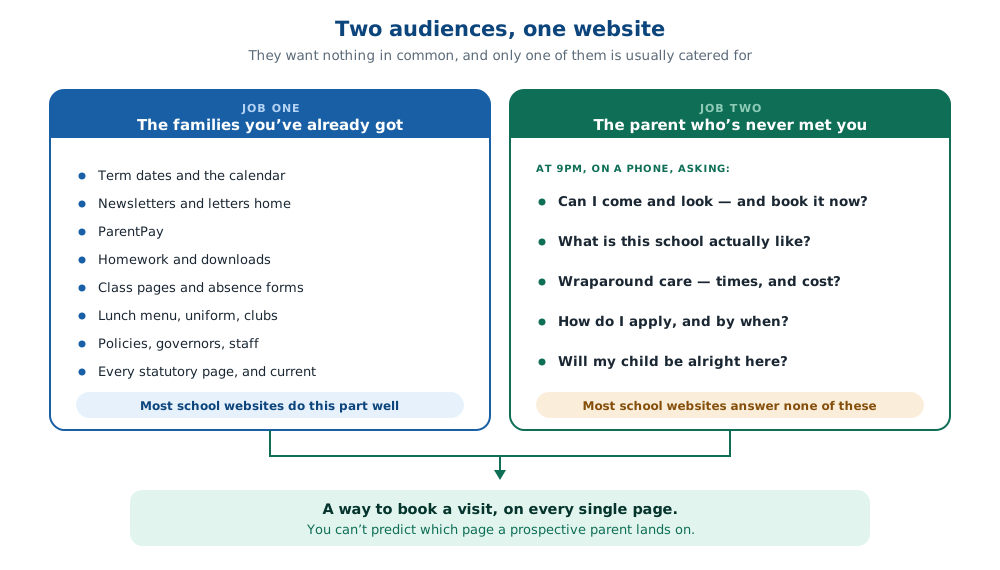
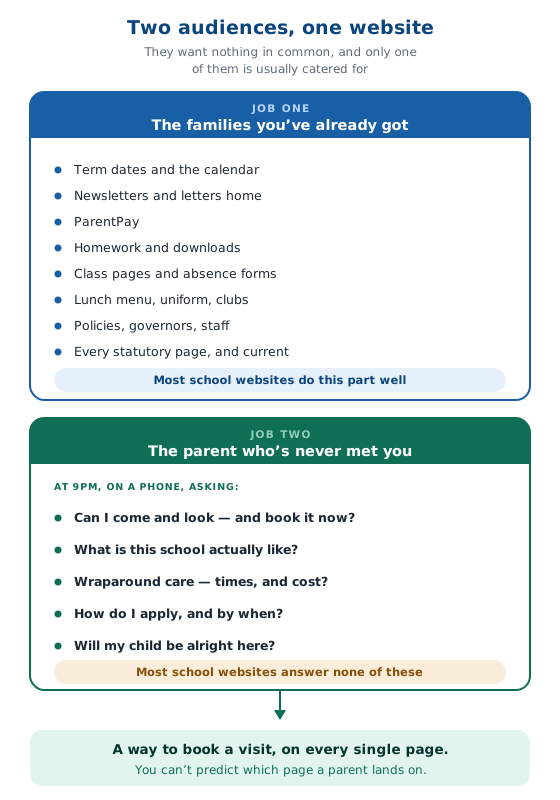
Quick answer: A school website has two jobs. The first is the one your families use every week — term dates, newsletters, ParentPay, homework, and every statutory page you're required to publish, all findable and current. That job is most of the work and it isn't optional.
The second is the one that decides whether your Reception class fills: convincing a parent who has never met you that this is a school worth visiting. Almost every school website does the first job and stops. The second is where the empty places are.
Your site has two audiences and they want nothing in common
One is already yours. They're checking whether it's a non-uniform day, paying for a trip, downloading a letter they've lost, or working out when term ends.
The other has never set foot in the building. They're deciding, at half past nine at night on a phone, whether your school is worth a Tuesday morning.
Both matter. Only one of them is usually catered for.
Job one: The site your families use every week
Let's take this seriously, because it's most of the work and it's the part that generates phone calls when it goes wrong.
The statutory layer isn't optional
Schools in England have to publish a specific set of things online — admission arrangements, curriculum, Ofsted, results, behaviour policy, SEN information and the SENCO's contact details, equality objectives, governance and the register of interests, financial information with a link to the school’s financial benchmarking service, complaints procedure, charging and remissions, uniform policy, values and ethos, and more.
Some of it is date-bound. The pupil premium strategy statement is due by 31 December each year. In primary schools, the PE and sport premium report is due by 31 July. Those are the ones that catch people out.
The requirements differ between maintained schools and academies, and they change — so rather than work from a list in a blog post, work from the current GOV.UK guidance for your school type.
Getting this right isn't an achievement, it's the floor. But a site that's visibly out of date on the statutory pages tells a prospective parent something they'll generalise from, and it's the first thing an inspector looks at.
The everyday layer has to actually work
Term dates and the calendar. Newsletters and letters home. ParentPay. Homework and downloads. Class pages. Absence reporting. The lunch menu. Uniform and where to buy it. Clubs and how to sign up. Governors. Staff.
Several hundred families use that every week. When something can't be found, your office answers the phone, which is the real cost of a badly organised school website.
The test is simple. Can a parent find the thing they came for in two clicks, on a phone, without asking anybody?
Somebody in your office has to be able to change it
This is the one schools regret afterwards.
If adding an event announcement, posting a newsletter or updating a policy requires raising a ticket with a supplier and waiting three days, two things happen. The site drifts out of date, and the people who could fix it stop trying.
Whatever platform you're on, the practical question is whether the person who actually does it — usually somebody in the office, often at four o'clock — can make a change in five minutes without being frightened of breaking something.
And it shouldn't cost a fortune to run
School websites have a way of becoming an annual bill that nobody can quite account for, on a platform nobody can leave.
Worth knowing what you're paying for hosting, what the support arrangement actually covers, whether you own your own domain, and whether you're tied in. If the answers are uncomfortable, that's worth knowing before the next renewal rather than after it.
It should also look like a school you'd want
This gets dismissed as vanity and it isn't.
Your website is the face of the school for anybody who hasn't been inside it, and it's also what your existing families see when they share you with a friend. A site that looks tired, or dense, or like it was built in 2014, says something about how the place is run — fairly or not.
Do all of that and you've got a good school website. Most schools that get this far are doing better than their neighbours.
You're also only halfway.
Job two: The site that fills your Reception class
Here's the reality that most schools don’t really grasp, which is understandable because you’re thinking like teachers not marketers!
Families don't discover you at your open morning any more. They arrive at it having already read your website, looked at your photographs, checked your Ofsted report and quietly seen what local parents say about you on Facebook. By the time they book a visit, they've shortlisted you.
Which means your website isn't just the information portal for existing parents, it’s the brochure that supports the open morning. It's what decides whether the open morning gets any takers at all.
And the parent looking at it like that has five specific things they're trying to do.
1. Find out whether they can come and look — and book it
This is the one. Everything else is about getting a family through your door, and this is the page where that either happens or doesn't.
Most school sites offer a phone number and an invitation to ring the office during working hours. The parent looking at your site is doing it at 9pm, after they’ve got their children to bed. They can't ring. They'll mean to tomorrow, and tomorrow will be busy.
A page with visit dates on it, bookable in forty seconds, is worth more than any other single change you can make. The mechanics are here, and how many visits to offer and when is here.
2. Work out what the school is actually like
Not what you say it's like. What it feels like.
This is where photography does the work, and where most school sites fall down — empty corridors, an exterior shot from the car park, a stock image of a globe. A parent looking at pictures of a building learns nothing about whether their child would be happy in it.
Photographs of your own children, doing ordinary things, tell them something no paragraph can. So does a short film, and so does a 3D walkthrough for the family who can't get to you yet. More on school photography here.
3. Check the practical things
Wraparound care, and what it costs. What time the day starts and ends. Uniform, and where to buy it. Whether there's a nursery. School meals. How far it is and where you'd park.
These are boring and they are decisive. A working parent who can't establish in two minutes whether you have breakfast club has learned something about how easy you'll be to deal with for the next seven years.
Wraparound care in particular deserves its own page rather than a line in a policy PDF. For a lot of families it's the single biggest practical factor in the decision.
4. Find out how to apply, and by when
The application isn't made to you — it's made to the local authority, and parents don't always know that. A page that explains the process plainly, names the deadline and links to the right council page removes a genuine source of confusion.
Primary applications in England close on 15 January. Put that date on the page, and update it when it passes, because nothing says nobody looks after this site like a deadline from last year!
5. Reassure themselves about their particular child
This is where a good website earns its keep.
The parent of a child with additional needs. The parent whose child is shy and would find a big school frightening. The parent whose child doesn't yet speak much English. The parent worried about their summer-born four-year-old coping.
None of them will ring and ask. All of them will look — and what they find is usually an SEN information report written for compliance rather than for them. A page that speaks to those families directly, in plain English, will do more for your Reception numbers than another paragraph about your values.
The sixty-second test
Open your school website on your phone. Not your laptop — your phone, which is what a parent is using.
Pretend you've never heard of the school. Now try to find out when you could visit, and book it.
If you can't do it in a minute, neither can they. And unlike you, they haven't got a reason to persist.
Do the same for wraparound care, and for how to apply.
Then do the first job's version of the same test: find this week's newsletter, and the uniform list.
Where this sits
The website is where most of the conversion actually happens — everything in the Fill Your Class Funnel either sends a family there or follows on from it. The posters and the advertising point at it. The visit is booked on it.
We build school websites that do both jobs — the statutory and everyday one so your office barely has to think about it, and the admissions one because that's what we're for. Builds start at £2,000 and most are under £5,000. The process takes about four weeks, and we do all the content transfer. In other words we make it easy for you. We also don’t lock you in but for as long as you stay with us (and no school has ever left yet!), we offer support from £500 per year which can cover everything you might need. You can see what's involved here.
But we'd rather be useful whether or not you ever talk to us. If you want to know honestly what we'd change about your site, send us the address — including if the answer is that it's fine and your problem is somewhere else. That's what the Marketing Health Check is for.
Frequently asked questions
What do parents look for on a school website?
Existing parents want term dates, newsletters, ParentPay, homework and policies, quickly and on a phone. Prospective parents want five different things: whether they can visit and how to book, what the school is actually like, practical details such as wraparound care, how and when to apply, and reassurance about their own particular child. Most school sites answer the first set and not the second.
What must a school website include by law?
Maintained schools in England must publish admission arrangements, curriculum information, Ofsted reports, results, behaviour policy, SEN information and SENCO contact details, equality objectives, governance and register of interests, financial information, complaints procedure, charging and remissions, uniform policy and more. Some items are date-bound — the pupil premium statement by 31 December, and in primaries the PE and sport premium by 31 July. Requirements differ for academies and they change, so work from the current GOV.UK guidance.
How important is a school website for admissions?
More than most schools assume. Families research a school thoroughly online before they ever visit, so the website usually decides whether the visit happens at all.
What's the single most valuable page to add to a school website?
A visit booking page with real dates that a parent can book without ringing the office. Most prospective parents are looking at your site in the evening, when nobody's there to answer the phone.
Should a school website have a separate page about wraparound care?
Yes. For a lot of working families it's the deciding practical factor, and a line inside a policy document isn't findable. Include the times and the cost.
Who should be able to update a school website?
Somebody in your own office, in about five minutes, without raising a ticket. If routine changes need a supplier and a wait, the site drifts out of date and nobody fixes it.
Why do photographs matter so much on a school website?
Because parents are deciding whether their child would be happy, and a photograph of children being ordinary tells them more than any paragraph. Empty corridors and exterior shots tell them nothing.
Ian Clifford is the co-founder of School Marketing Works and has been running admissions campaigns for UK schools since 2018, including the one documented in our published falling school roll case study.