
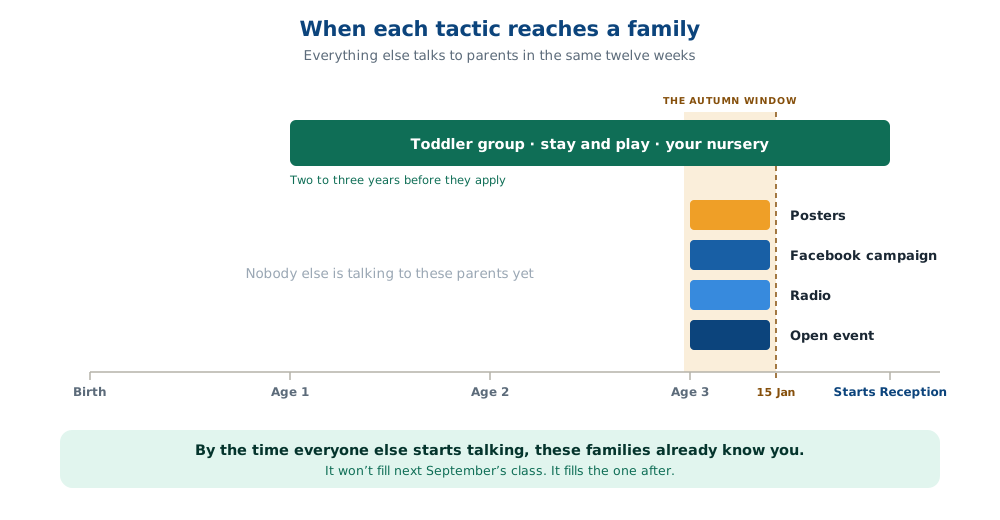
Quick answer: Posters, Facebook, radio and open days all reach parents in the same twelve weeks — the autumn before the January deadline, by which point many families have already heard the local opinion and half-decided.
Toddler groups, stay-and-play sessions and your own nursery reach the same families a year or two earlier, when nothing is settled. It's slower than everything else in this funnel but it gets you in front of a parent before anybody else does.
Everyone arrives at the same moment
Look at the admissions calendar and you'll notice how crowded one end of it is.
Posters go up in September. Facebook campaigns run through the autumn. Any other marketing you’re testing runs in the same window. Open mornings or bookable tours land between late September and early December. Applications close on 15 January.
So every school in your town is talking to the same parents at the same time, and by then those parents have been talking to each other for a year. They've heard which school people like. They've formed a rough shortlist from the school gate, the toddler group and their neighbour's opinion.
Pre-Reception events are how you get into that conversation before it happens.
What counts as a pre-Reception event
Four things, roughly in order of how much work they are.
Your own nursery, if you have one. The single biggest source of Reception children most primaries will ever have, and the one most often taken for granted.
Stay-and-play sessions for families who haven't applied yet. An hour in the Reception classroom, the sand and water out, the Reception teacher on the floor with the children, someone from the leadership team making tea and answering questions.
A weekly parent-and-toddler group in the hall. Rhyme time, messy play, baby-and-bumps. Run by a TA, an hour a week, open to anybody local. If you can’t manage weekly, try monthly
Links with the nurseries and childminders near you — the ones whose children have to go somewhere at four. Invitations to your events, a visit from your Reception teacher, a transition morning.
Stay and play is already in your school. It's pointed the wrong way.
A lot of English primaries already run stay-and-play sessions. Look at almost any school's admissions page and you'll find them.
Nearly all of them are in the summer term, for children who already have a place, as part of transition.
That's a good thing to do, but it isn't marketing. The families are already yours. Running the same session in October, for families who have not applied and may never have set foot in the building, is a completely different exercise using the same room, the same staff and the same sand tray.
A parent who has watched their two-year-old happily play in your Reception classroom is not going to choose a school off a website in January. They've already seen the thing everybody else is trying to describe.
The nursery place that costs you a Reception place
We've seen this happen more than it should.
Attending your nursery does not get a child a place in your Reception class. The parent still has to make an application to the local authority, on the common application form, by 15 January, the same as everybody else.
A lot of parents don't know that. They assume the child is already in the school, because from where they're standing the child is already in the school — same gate, same uniform in some cases, same staff. They miss the deadline, become a late applicant, and get processed after everyone who applied on time.
You lose a child you already had. So does the family, who wanted you.
Three things to do about it:
- Write to every nursery parent in November and again in early January, saying plainly that they must apply, how, and by when.
- Say it on your website, on the nursery page and the admissions page, in the same words.
- Check your own oversubscription criteria and be honest about them. A small number of schools do give priority to children from their own nursery, but it's uncommon — it has to be consulted on locally, has to be fair to families who didn't use the nursery, and can be challenged at the Schools Adjudicator. For most schools the honest answer is that the nursery counts for nothing in the allocation. Whichever is true of yours, say it plainly on the nursery page. A parent who finds out in April that nursery attendance counted for nothing will not be quiet about it.
That is free, takes an afternoon, and is the highest-return thing in this entire article.
If you're getting a new nursery
The DfE has been funding primary schools to open and expand nurseries on their own sites. A further 331 schools were awarded a share of £45 million in March 2026, for provision opening from September 2026, and the programme moves to a local-authority planning model from 2027.
If your school is one of them, you've been handed something bigger than a nursery. You've been handed a route by which local families enter your building at two and three years old instead of meeting you for the first time at an open morning.
That only works if you market the nursery as hard as you'd market the school. New nurseries do not fill themselves either, and a half-empty nursery feeds a half-empty Reception two years later.
Why a toddler group works
It isn't the activities. It's the repetition.
A parent who has been into your school twenty times over two years knows where the toilets are, knows the office staff by name, knows what the corridor displays look like in February as well as on an open morning. They've seen the school when nobody was performing.
That parent is not comparing schools. They're deciding whether to leave one.
It also reaches the families you can't reach any other way. Parents at home with a second baby. Parents new to the area with nobody to ask. Parents who wouldn't book a formal tour because it feels like an interview.
And the truth is that when a parent comes to a toddler group they're not thinking about the school. They're thinking about the opportunity to meet other parents and for their child to play and have fun while meeting other kids. So it's a very soft sell.
What it costs, honestly
A weekly toddler group run by one teaching assistant for an hour a week is roughly 38 hours across the school year, plus setup and a box of biscuits.
Set that against what a single empty Reception place costs — around £5,115 a year, and seven years of it if the child never joins. One additional child pays for the group several times over.
The real cost isn't money, it's whether anyone owns it. Groups that get handed to a willing parent volunteer and no member of staff tend to run brilliantly for a term and then stop.
Five ways schools waste this
Nobody from the school is visibly there. If the group runs in the hall and no member of staff appears, the parents have been to a toddler group, not to your school.
It happens nowhere near the Reception classroom. The point is the room their child would be in. A hall could be any hall.
Nobody takes a name. A register with a name, an email address and the child's date of birth turns a toddler group into a list of families you can invite to your open event two years running.
Admissions never gets mentioned. Not a hard sell. But at some point in the autumn, someone should say out loud that applications for next September close on 15 January, that everyone here is welcome to come to the open morning, and here's how to book.
They aren't invited to the open event. Every family on that register whose child turns four in the coming year should get a personal invitation. That is the warmest list your school has.
How you know if it's working
Add one line to your visit booking form and your open event sign-in: have you been to one of our toddler sessions or stay-and-play mornings?
Do that for two years and you'll know exactly what this is worth, which is more than most schools can say about any of their marketing. The booking system is where that data comes from.
The honest caveat
This will not fill your Reception class next September.
The children at your toddler group this term start school in 2028 or 2029. If you're fifteen short for this coming intake, the things that move that number are your open event, your Facebook campaign, your posters and what a parent finds on your website at nine at night.
Pre-Reception events are what you start now so that in two years the autumn is easier. Every school that has a strong local reputation for its toddler group built it years before it needed it.
Where this sits
Pre-Reception events sit at the very top of the Fill Your Class Funnel — earlier than anything else in it. They feed the same place everything else feeds: a booked visit, a family through the door, an application in January.
If you're not sure which part of this to start with, the Marketing Health Check will tell you where the gap is.
Frequently asked questions
What are pre-Reception events?
Anything that brings local families with children under four into your school before they apply — toddler groups, stay-and-play sessions in the Reception classroom, nursery open mornings, and links with nearby nurseries and childminders.
Does attending a school nursery guarantee a Reception place?
No. Nursery provision isn't statutory education, so parents must still make a separate application through the local authority by the national closing date of 15 January, exactly like a family who used no nursery at all. Schools lose children they already had this way every year.
Can a school give priority to children from its own nursery?
It's permitted but uncommon. Any such priority has to be consulted on locally, has to remain fair to families who didn't use the nursery, and can be objected to at the Schools Adjudicator if it leaves too few places for everyone else. For most schools the honest answer is that the nursery counts for nothing in the allocation — so say that plainly on your nursery page rather than letting parents assume otherwise.
When should a school run stay-and-play sessions for prospective parents?
In the autumn term, alongside your tours and open event, for families who have not applied yet. Most schools only run them in the summer for children who already have a place, which is transition rather than recruitment.
How long does it take for a school toddler group to affect admissions?
Two to three years. The children attending now apply for Reception in 2028 or 2029. It's the slowest thing in a school marketing plan and the hardest for a competitor to copy.
How much staff time does a weekly toddler group take?
Around an hour a week of one member of staff's time, or roughly 38 hours across the school year. One additional pupil covers that cost many times over.
What should we do with the families who come?
Keep a register with a name, an email address and the child's date of birth, and personally invite every family whose child turns four in the coming year to your open event.
Ian Clifford is the co-founder of School Marketing Works and has been running admissions campaigns for UK schools since 2018, including the one documented in our published falling school roll case study.